Areca Palm Leaf Plates: How to Specify Grades, Thickness and Color Variation
Key points
- Areca leaf plates are pressed from natural sheaths, so no two pieces match, and no industry standard defines grade A, B or C.
- A written grading sheet with photos, plus limits for thickness, moisture and defects, turns natural variation into something you can accept or reject.
- Moisture is the main hidden risk, so specify it as a number and ask how finished goods are dried and packed for sea freight.
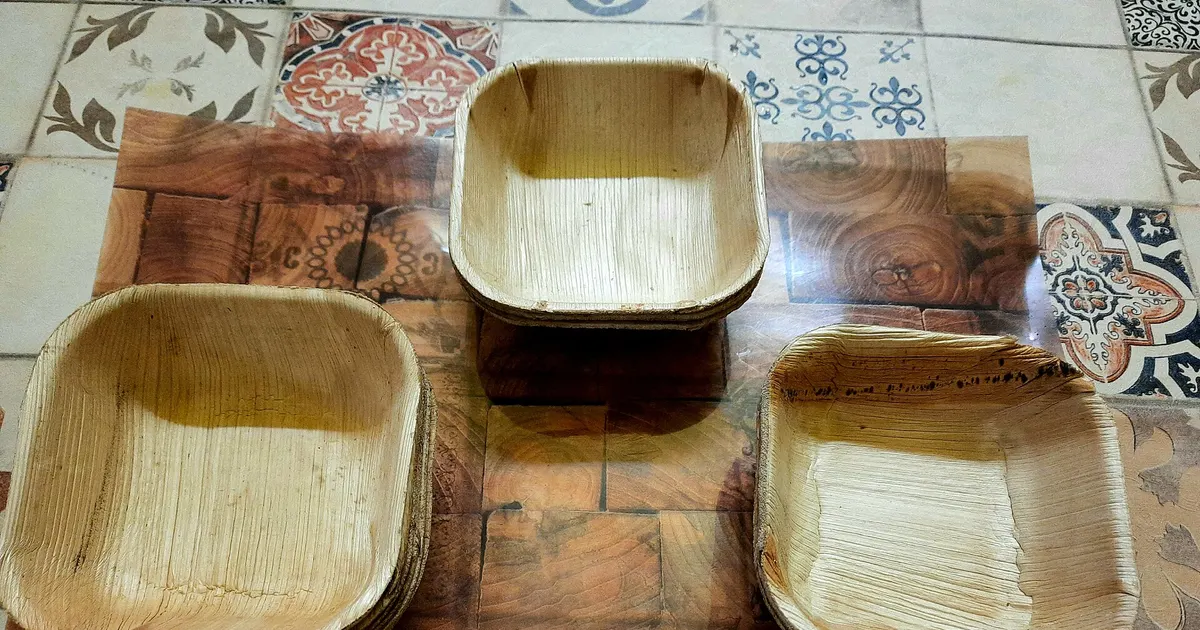
Ask three areca leaf plate suppliers for grade A and you may get three different plates. There is no international standard for palm leaf grading, and the sheath is a natural material that varies by tree, season and drying. A buyer who accepts the word “grade A” instead of a defined standard is accepting someone else’s definition of it.
This guide shows how to turn natural variation into a specification: what grades usually mean, how to measure thickness and moisture, which defects to name and how to inspect a shipment. For the wider material comparison with bagasse, see our guide to bagasse vs areca leaf vs rice and grass straws.
How areca plates are made
Areca palm leaf plates are made from the sheath that falls naturally from the areca palm, not from the green leaf blade. Sheaths are collected, cleaned, softened with water and pressed in heated dies, then trimmed and dried. Standard products use no glue, coating or binder, so the pressed plate keeps the grain, color and small marks of the sheath.
In Vietnam, palm leaf work is concentrated in provinces near the Cambodian border. The pressing is usually done on hand-fed presses, which is why output and consistency depend on operators and on raw sheath quality.
Two things follow from this. Because sheath size limits plate size, deep or very large plates are hard to make. And because the material is natural, variation is not a flaw to eliminate but a range to define.
Color variation: define the range
Areca plates range from light tan to dark brown, often within one carton. Streaks, fine grain lines and small darker spots are normal. What buyers care about is whether the plate looks as they expect and as their customers will accept.
The practical approach is a reference set:
- Ask the factory for 20 or more sample pieces from a normal production run, not hand-picked pieces.
- Sort them into the grades you want and photograph each grade on a neutral background with a scale.
- Keep the physical set, and give the photos to the factory as the grading standard.
- Mark the borderline pieces for each grade, so that the line between grade A and grade B is visible.
Without a physical reference, a color dispute is a matter of opinion.
A grading scheme you can adapt
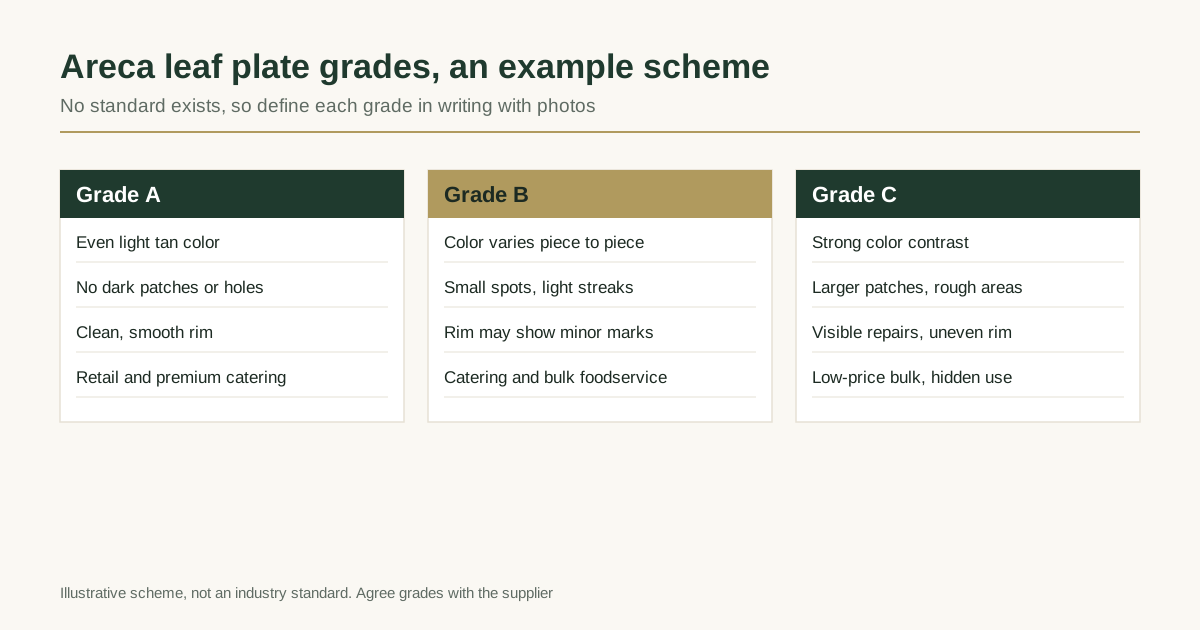
The scheme below is an example, not a standard. Write your own, with the factory, and sign it.
| Grade | Typical description | Typical use |
|---|---|---|
| A | Even light tan color, no dark patches, no holes, clean smooth rim | Retail packs, premium catering |
| B | Color varies piece to piece, small spots and streaks, minor rim marks | Catering and bulk foodservice |
| C | Strong color contrast, larger patches or rough areas, visible repairs | Low-price bulk, items with hidden use |
Add numbers wherever you can: the largest allowed spot in millimeters, the number of spots per plate and the maximum crack length at the rim. A sentence like “no dark patch larger than 10 mm” is checkable, and “clean appearance” is not.
Thickness and strength
Thickness varies within a piece, since the sheath is thicker in some places than in others, and pressing compresses it unevenly. Many plates fall roughly between 0.7 and 1.5 mm in the flat area, with deeper bowls thicker at the walls and thinner at the curve. These are indicative ranges, not guarantees.
| Check | How | What to record |
|---|---|---|
| Thickness | Caliper at 5 points: base center, base edge, wall, rim, corner | Minimum, maximum, average |
| Weight | Scale, 10 pieces | Average and spread |
| Rigidity | Hold at the edge and press, or a simple load test | Flex and any cracking |
| Edge quality | Look and touch | Cracks, splits, rough edges |
A thicker plate is stronger but costs more raw material. Set a minimum thickness and a weight window, and let the supplier choose how to meet them.
Moisture and mold
Palm leaf absorbs moisture, which makes it the main hidden risk of the category. A plate that feels dry at the factory can grow mold in a container if its moisture is high, if cartons are packed warm or if sea transit brings condensation.
Put moisture in the specification as a number, for example a maximum percentage at the time of packing, with the measurement method. Ask these questions:
- How are finished plates dried and for how long?
- What moisture do you measure, how and how often?
- What packing is used: liners, desiccants, sealed bags, carton coating?
- What happens to a lot that fails the moisture check?
Our guide to first-order timelines shows how the 20 to 30 days of sea freight fit into the plan, which matters for a moisture-sensitive item.
Other defects to name
- Cracks and splits. Common at the rim and corners, often from over-dry sheaths.
- Holes and thin spots. Where the sheath was damaged or pressed too hard.
- Bubbles and delamination. Layers that separate on the plate surface.
- Burn marks. Dark marks from overheating the die.
- Dust and loose fiber. On the surface and rim.
- Odor. A damp or musty smell is a warning.
- Warping. Plates that do not sit flat or nest.
Assign each defect a class, in the same way as for other tableware, with a sampling plan. Our guide on pre-shipment inspection and AQL shows how to set classes and sample sizes.
MOQ, lead time and capacity
A common starting point is around 50,000 pieces per item, and raw sheath availability can shift with the season. Ask about stock and capacity before you plan a promotion. Hand-fed pressing means capacity depends on the number of presses and operators, so large orders may need extra weeks.
Compostability and food contact
Areca plates are made of plant material with no binder, but a formal compostability certificate is less common than for bagasse, and any certificate is item specific. We do not verify or confirm any manufacturer’s certificate (BPI, TUV Austria OK compost, ASTM D6400 or EN 13432). Request the original and check it with the issuer. For food contact, ask what testing exists for the exact item. Our guide to compostability certificates and food contact tests explains what to ask.
How biopackvn.com fits in
We are a matching service, not a factory and not an agent that manages orders. You send an RFQ, we reply within 24 business hours and we introduce up to 3 Vietnamese manufacturers that suit your item and volume. You then deal with them directly on grading, samples and price. It is free for buyers, we take no commission and we sign an NDA on request.
Next step
Include these in your RFQ:
- Item: shape, diameter or dimensions and depth
- Grade: your grade definition or request a factory sample set to sort
- Thickness and weight: minimum thickness and a weight window
- Moisture: maximum percentage at packing and packing method
- Volume: first order and expected annual quantity
- Documents: food contact tests and any certificate you require for the exact item
Browse the range on our compostable packaging sourcing page and then send your RFQ.
Frequently asked questions
What are areca leaf plate grades?
Grades are a supplier's own scheme for sorting pieces by appearance, usually A for the cleanest and most uniform and lower letters for more spots, streaks or visible marks. No industry standard defines them, so one factory's grade A may differ from another's. Define each grade in writing with reference photos.
How thick is an areca leaf plate?
Thickness depends on the sheath and the pressing, and it varies within a piece. Many plates fall roughly between 0.7 and 1.5 mm, with deeper bowls often thicker at the walls. Measure at several points on samples with a caliper and agree a minimum in the specification.
Why do areca leaf plates differ in color?
The sheaths are natural and vary in age, moisture and growing conditions, so color ranges from light tan to dark brown, with streaks and grain. Color is not a defect unless it falls outside your grading sheet. Approve a set of reference pieces before production.
BioPack VN is a matching service, not a manufacturer. Figures above are typical market ranges for planning, not quotes, and we do not confirm any manufacturer's certificates. Send an RFQ to be introduced to up to 3 Vietnamese manufacturers within 24 business hours.