Custom Molds for Bagasse Packaging: What Tooling Costs and How Long It Takes
Key points
- A custom bagasse shape needs a tool set of several parts, so the price depends on size, cavity count, surface finish and design complexity.
- Spread across total volume, tooling is often a small per-piece cost, which is why custom shapes make sense for steady, high-volume items.
- Agree ownership, exclusivity, storage and refund terms in writing before you pay for any mold.
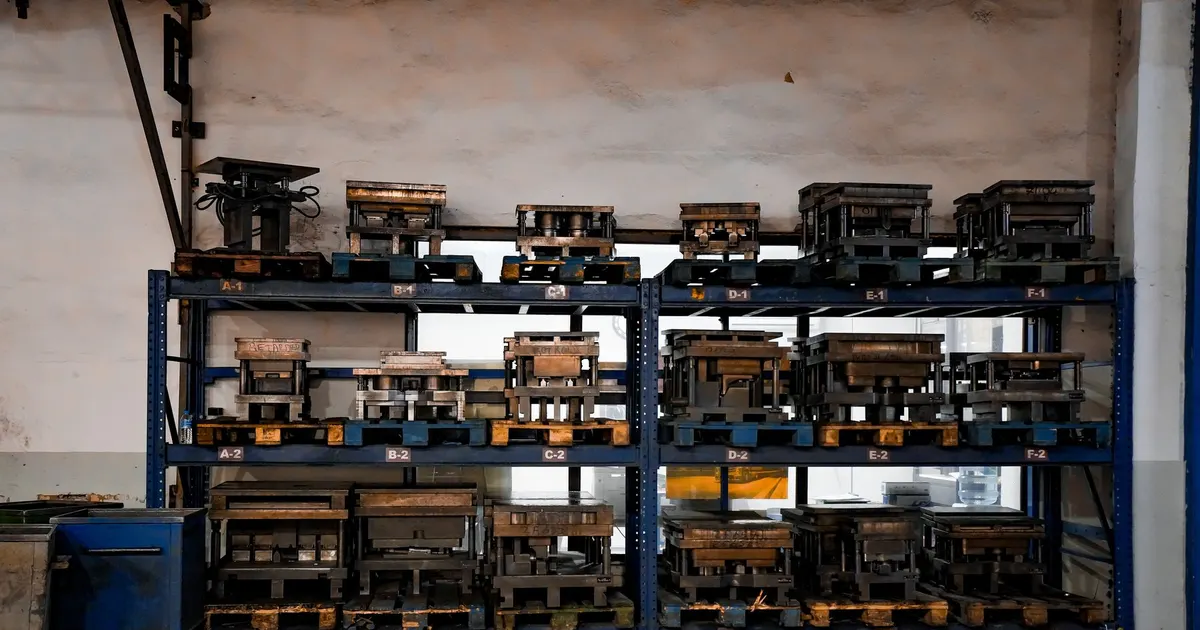
A custom shape is the most visible choice in a bagasse program. It is also the one that adds tooling cost, an extra approval step and weeks to the timeline. Buyers often ask for a single price for a mold, and the honest answer is a range, because the number depends on what is inside the tool set and how the item is built.
This guide explains what you pay for, what drives the price and the timeline, how tooling cost looks when spread across volume, and which design choices save money and trouble. For minimum orders and the first-order calendar, see our guide to MOQ, molds and lead time for a first order.
What a tool set contains
One item usually needs several tools, each mounted on a different machine in the line. Descriptions and materials vary by factory, so ask for the list.
| Tool | What it does | Notes |
|---|---|---|
| Forming mold | Metal body covered with fine mesh, shapes the wet blank under vacuum | Mesh condition affects thickness and surface |
| Transfer mold | Moves the wet blank to the press | Not every line has a separate one |
| Hot-press molds (upper and lower) | Press and heat the blank to set the shape and surface | Where embossed logos and surface texture are cut |
| Trimming die | Cuts the rim to final size | Wear shows up as burrs |
| Logo insert (optional) | Replaceable plate carrying the logo | Allows logo changes without a new mold |
Because the forming and press tools have to match each other, a new shape means a new set, not a single part. Pieces for a lid and its base are two separate sets.
What drives the price
Tooling price depends on a handful of factors:
- Size. Larger items need larger tools and more metal and machining time.
- Cavity count. A production tool can press several pieces per cycle. More cavities raise the price, but not in direct proportion, and they cut the cost per piece in production.
- Depth and complexity. Deep draws, internal dividers, ribs and lid snap features add machining and trial time.
- Surface finish. Smooth polished surfaces and textured areas both add machining and finishing steps.
- Materials. Tool metals and surface treatments affect both cost and wear life.
- Logo and text detail. Fine detail raises the machining precision needed.
Typical figures, to be confirmed with the factory: a simple small tool can cost a few hundred USD, a typical production set often runs in the low thousands and large multi-cavity sets cost more. A quote without a stated scope (which tools, how many cavities, which finish) cannot be compared with another one.
Tooling cost spread across volume
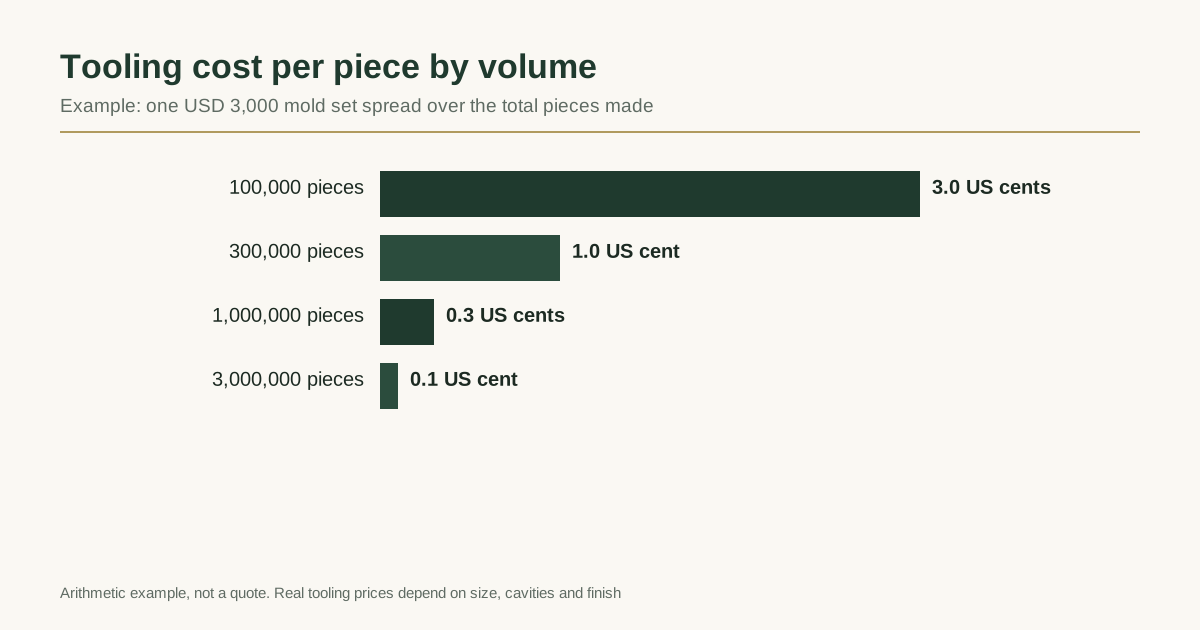
Tooling is paid once and the pieces keep coming. A simple amortization shows why a custom shape often costs only a small amount per piece on a steady program.
| Tool price | 100,000 pieces | 300,000 pieces | 1,000,000 pieces |
|---|---|---|---|
| USD 2,000 | 2.0 US cents | 0.7 US cents | 0.2 US cents |
| USD 3,000 | 3.0 US cents | 1.0 US cent | 0.3 US cents |
| USD 5,000 | 5.0 US cents | 1.7 US cents | 0.5 US cents |
This is arithmetic, not a quote. The point is that a one-off promotion of 20,000 pieces carries a very different tooling burden from an item that runs for years. Compare it with the price of the piece itself, which our guide to bagasse packaging cost from Vietnam breaks down.
The path from drawing to sample
A typical sequence looks like this:
- Design review (about 3 to 7 days). The factory engineer checks draft angles, wall transitions, depth and tolerances and returns comments.
- Design freeze and quote. You approve the final shape and the tooling scope, and pay the deposit.
- Tool machining (typically 15 to 25 days). The tool set is cut, finished and assembled.
- First samples. The tool is trial-pressed and samples are measured and photographed.
- Revisions (often one or two rounds). Fit, thickness, rim shape or lid closure is corrected, usually by adjusting the tool.
- Approved sample and production release. You sign the sample as the reference, with weight and dimensions recorded.
From an approved drawing to an approved sample, roughly 4 to 6 weeks is a realistic planning figure. Production then follows its own 30 to 45 day clock after order confirmation.
Design rules that save money
Ask your factory for its own rules, and then check these common points:
- Draft angle. Walls need some taper so the piece releases from the mold. Many factories ask for several degrees, often 5 degrees or more, and deeper pieces need more.
- Wall transitions. Sharp internal corners and abrupt thickness changes cause thin spots. Generous radii help.
- Depth. Very deep draws are hard to form evenly. A shallower shape or a wider top can solve the problem.
- Undercuts. Features that lock the piece into the mold are not practical for pulp tooling.
- Stacking. Add small lugs or ribs so nested pieces separate easily, and so a stack does not jam.
- Lid fit. Ask the factory to specify the base and lid as a matched pair, with a stated tolerance on both rims.
- Standard dimensions. An existing diameter or footprint often lets you reuse part of a tool or a trimming die.
A pressed piece shrinks and moves slightly as it dries, so the factory’s engineering team adjusts the tool to the result. That is why one or two sample rounds are normal.
Ownership and risk: what to settle in writing
Before you pay for tooling, agree these points:
- Ownership. Is the mold yours, and is that written in the order terms?
- Exclusivity. Can the factory use your shape for other customers?
- Refund terms. Some factories credit part or all of the tooling price after a cumulative volume. Get the threshold and the mechanism in writing.
- Storage. How long will the factory keep the mold between orders and in what conditions?
- Maintenance and wear. Who pays for repair or refurbishment, and what life in production cycles does the factory expect?
- Transfer. Molds are built for a specific machine, so moving a tool to another factory may not be practical. Plan on the basis that it stays where it was made.
- Drawings and data. Keep your own copy of the design files and the signed sample specification.
Stock shape or custom shape
| Situation | Better choice |
|---|---|
| Market test, small first order | Stock shape on an existing mold |
| Brand needs a proprietary shape | Custom mold |
| Lid must match an existing base | Custom mold for the lid, or check stock lids first |
| Logo only | Stock shape with a logo insert |
| Annual volume is uncertain | Stock shape first, then custom once volume is proven |
How biopackvn.com fits in
We are a matching service, not a factory and not an agent that manages orders. You send an RFQ, we reply within 24 business hours and we introduce up to 3 Vietnamese manufacturers that suit your item and volume. You then deal with them directly on tooling terms, samples and price. It is free for buyers, we take no commission and we sign an NDA on request before you share drawings.
Our bagasse tableware and molded fiber sourcing page lists standard shapes you can check first.
Next step
For a custom mold RFQ, send:
- Design files: a STEP file and a drawing with critical dimensions, plus a reference sample if you have one
- Item data: target weight, wall thickness range and lid or stacking requirements
- Volume: first order and expected annual quantity, since tooling terms depend on it
- Tooling terms wanted: ownership, exclusivity and refund conditions
- Food contact and certificate needs: for example PFAS-free and compostability documents for the exact item
Send your RFQ here and we will start matching.
Frequently asked questions
How much does a custom bagasse mold cost?
It varies with size, cavity count and finish. A simple small tool can cost a few hundred USD, a typical production set often runs in the low thousands and large multi-cavity sets cost more. Ask each factory to list exactly which parts the price covers, and compare the same scope.
How long does a custom bagasse mold take?
Tooling typically takes about 15 to 25 days after the design is frozen, followed by sample pressing and often one or two revision rounds. Plan roughly 4 to 6 weeks from approved drawing to an approved sample, before production starts.
What files should I send for a custom mold?
Send a 3D file such as STEP, a 2D drawing with critical dimensions and tolerances, the target weight and a reference sample if you have one. Ask the factory engineer to review draft angles, wall thickness, stacking height and lid fit before steel is cut.
BioPack VN is a matching service, not a manufacturer. Figures above are typical market ranges for planning, not quotes, and we do not confirm any manufacturer's certificates. Send an RFQ to be introduced to up to 3 Vietnamese manufacturers within 24 business hours.