Bagasse Coffee Cup Lids: Fit Tolerance, Heat Testing and Drinking Feel
Key points
- A fiber lid fits only if its skirt matches the rim of the specific cup it goes on, so lids and cups must be tested together.
- Heat, steam and spills test the fit and the fiber, and the area around the sip opening is where softening and edge feel show first.
- Treat lid and cup as separate items with separate documents, and agree dimensions, tolerance and a sign-off sample in writing.
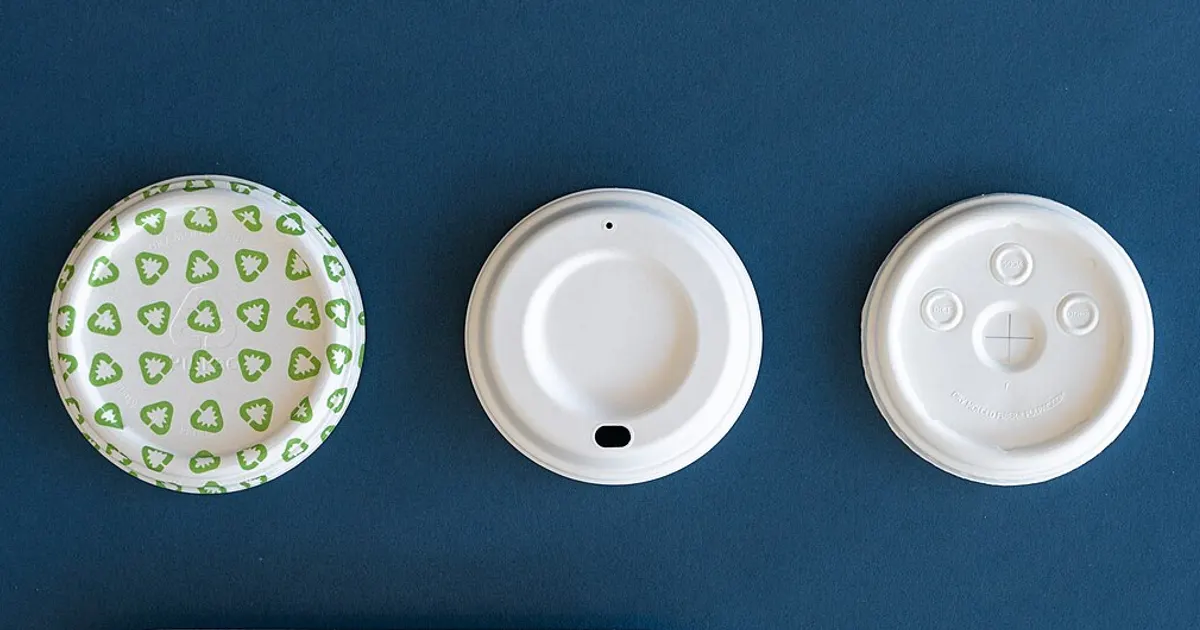
A lid is a small item with a big share of the complaints. A loose lid spills coffee on a laptop, a tight lid crushes the cup rim, and a lid that goes soft near the sip hole gives customers a bad last impression. Lids fail at the fit, so the fit has to be specified like any engineering part.
This guide covers how to specify fiber cup lids, how to test them with heat and spills, what to ask about drinking feel and how to treat the lid and cup as a pair. For the forming process behind the lid, see our guide to how bagasse tableware is made. Figures are typical ranges to confirm with the manufacturer.
How a lid fits a cup
A hot-cup lid works by gripping the rolled rim at the top of the cup. The lid skirt, a short vertical wall around the lid’s edge, sits over the rim bead and holds by friction and a small snap. Three dimensions decide the fit:
- Top diameter of the cup, measured at the outside of the rim bead.
- Rim bead profile, its height and curl, which changes between cup makers.
- Lid skirt inner diameter and height, which must match the cup with a small clearance.
Common top diameters are about 80 mm for small hot cups (around 8 oz) and about 90 mm for 12 to 20 oz cups, with other sizes for espresso and large cups. These are common sizes, not universal rules, so measure your actual cup.
Molded fiber lids vs plastic lids
Plastic lids are thermoformed or injection molded and can be made with fine snap features. Fiber lids are pressed from pulp, which gives a less crisp profile and a slightly rougher surface. As a result:
- The fit tolerance on a fiber lid is usually wider, and the grip is mostly friction.
- Fine features such as a recessed sip opening are harder to make.
- Fiber is not transparent, so the customer cannot see the drink.
- Fiber can soften with steam and spills, which does not happen with plastic.
For these reasons, fiber lids work best for hot drinks served within a modest time, from a well-matched cup. Fiber dome lids for cold drinks with straws are less common than plastic, so ask about availability for your use.
Fit tolerance: specify it
Ask the supplier for a drawing and state a tolerance on the lid skirt diameter and height. Many buyers work from a small range of a fraction of a millimeter to about a millimeter on diameter, but the right range depends on the cup and the lid, and the factory’s process capability. Ask the factory what it can hold.
| Parameter | What to specify | How to check |
|---|---|---|
| Skirt inner diameter | Target and tolerance in mm | Caliper on 10 pieces |
| Skirt height | Target and tolerance | Caliper |
| Fit on the exact cup | Fits without crushing the rim | Fit test on production cups |
| Push-on and pull-off force | Minimum and maximum | Hand feel or force gauge |
| Sip opening | Size, shape, edge finish | Visual and sip test |
| Vent | Present or not, size | Visual and steam test |
| Stack height and nesting | Lids separate easily | Stack 20 and pull one |
| Weight | Target and tolerance | Scale |
Fiber moves slightly with moisture, so measure at the moisture level the lid will have in use, and recheck after storage.
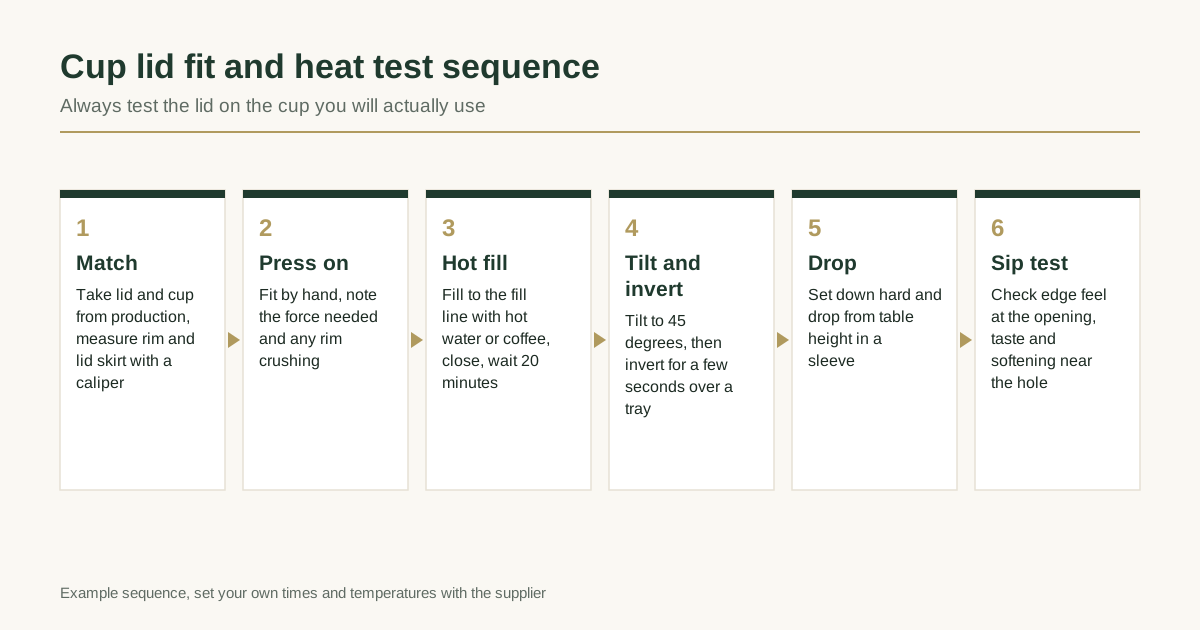
Test plan
Run these on lids and cups from production, not from hand-picked samples.
| Test | Example method | What to record |
|---|---|---|
| Fit | Press lid on by hand, then remove | Force, rim crushing, lid distortion |
| Hot fill | Fill to the line with hot water or coffee, close, hold about 20 minutes | Softening, warping, leaks at the skirt |
| Tilt | Hold at 45 degrees, then invert for a few seconds over a tray | Leaks, lid pop-off |
| Drop | Drop a filled cup in a sleeve from table height | Lid loss, cracks |
| Steam | Check condensation under the lid at the end of the hold | Dripping, softening near the opening |
| Sip | Drink through the opening | Edge feel, taste, texture |
| Storage | Hold lids in humid conditions, retest fit | Warp, mold, odor |
For heat testing, see the general approach in our guide to microwave, oven and freezer tests. The same discipline applies: use your real drink at your real temperature, and record what you saw.
Drinking feel and taste
Customers feel the opening with their lips. A fiber edge can feel rough or fibrous, and a poorly trimmed opening has loose fibers. Ask for a sample opening to be sanded or formed smooth, and test it on people.
Fiber can also affect the aroma or taste of a drink, especially coffee. A sensory check, tasting a drink with and without the lid, is a simple test that avoids expensive surprises.
Barrier additives and food contact
The lid’s inner surface touches hot steam and sometimes the drink. Water and oil resistance comes from additives, and PFAS-free status matters for food contact in many markets. Ask for documents for the exact lid and see our guide to PFAS-free molded fiber packaging.
The cup is a separate item
Paper cups are normally lined with a thin plastic or bio-based layer for liquid resistance. The lid and the cup are separate products with separate documents and separate certificates. A compostability certificate for a lid does not cover a cup, and the reverse is also true. If you plan a claim for the pair, check each item’s certificate, and discuss the combined claim with a compliance advisor.
We do not verify or confirm any manufacturer’s compostability certificate (BPI, TUV Austria OK compost, ASTM D6400 or EN 13432). Request the originals and check them with the issuer. See our guide to compostability certificates and food contact tests.
In the EU, beverage cups and their lids made of plastic fall under the Single-Use Plastics Directive, and cup linings can matter. See our guide to the EU Single-Use Plastics Directive.
Cost, tooling and minimums
A lid needs a mold set for each size. Ask for the tool price and the factory’s list of stock sizes before commissioning a custom lid. Pricing depends on size and weight, and minimums are typically per size, often at container level for stock items. For tooling, see our guide to custom molds for bagasse packaging.
How biopackvn.com fits in
We are a matching service, not a factory and not an agent that manages orders. You send an RFQ, we reply within 24 business hours and we introduce up to 3 Vietnamese manufacturers that suit your item and volume. You then deal with them directly on samples, fit testing and price. It is free for buyers, we take no commission and we sign an NDA on request.
Next step
A useful RFQ for cup lids includes:
- Cup data: brand or maker, size, a physical cup sample and a drawing if you have it
- Lid features: sip opening, vent, color
- Use: drink types, temperatures and hold times
- Volume: first order and annual quantity per size
- Documents: PFAS status, food-contact tests and certificates for the exact lid
See our bagasse tableware sourcing page and then send your RFQ.
Frequently asked questions
What sizes do cup lids come in?
Lids are sized by the top diameter of the cup, commonly around 80 mm for small hot cups of about 8 oz and around 90 mm for 12 to 20 oz cups, with other sizes for espresso and large cups. Sizes are not universal, so measure the actual cup rim and ask the lid supplier for a drawing.
Why does a lid fit one cup brand and not another?
Cups from different makers have different rim bead height, wall angle and wall thickness, and the lid skirt is made to grip a particular profile. A small difference can make the lid loose or too tight. Test the lid on the exact cup you will buy and agree a fit tolerance.
Do fiber lids soften with hot drinks?
They can soften around the sip opening and where condensation collects, especially over long hold times. Test with your drink at serving temperature for the time a customer takes to finish it. Ask the supplier for its stated limits and the test behind them.
BioPack VN is a matching service, not a manufacturer. Figures above are typical market ranges for planning, not quotes, and we do not confirm any manufacturer's certificates. Send an RFQ to be introduced to up to 3 Vietnamese manufacturers within 24 business hours.