EU Single-Use Plastics Directive: What It Means for Fiber, Wood and Plant-Based Packaging
Key points
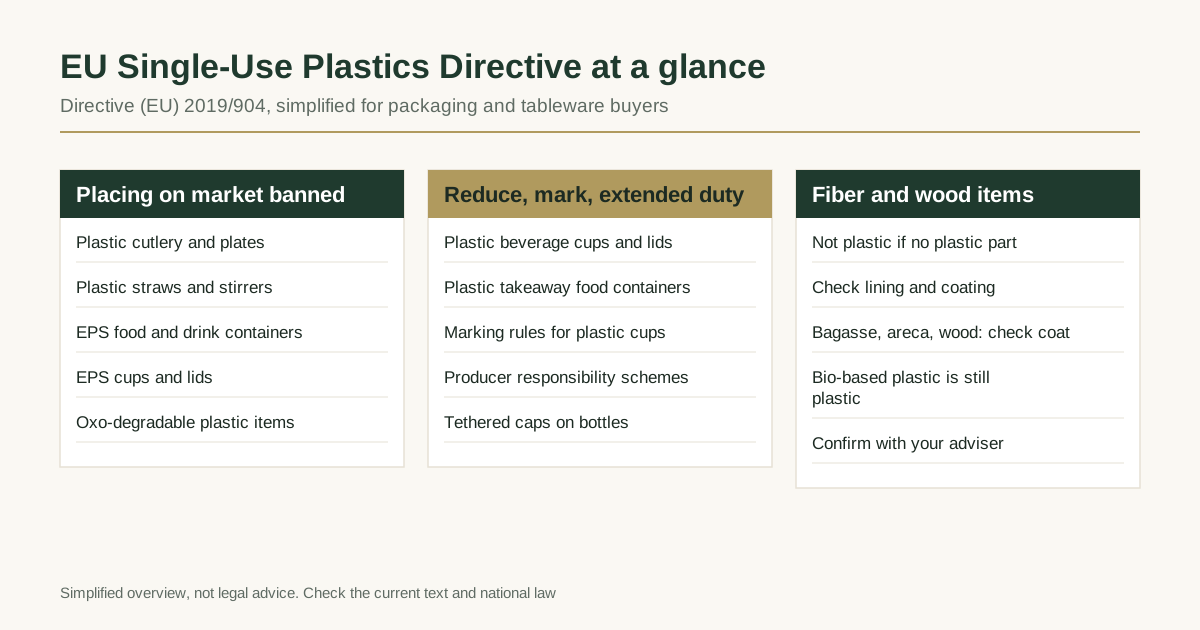
- Directive (EU) 2019/904 bans some single-use plastic items such as cutlery, plates, straws and expanded polystyrene food and drink containers, and it limits and marks others such as cups and takeaway containers.
- Fiber and wood items are not plastic if no plastic is part of them, but a plastic lining or coating can bring them into scope, and bio-based or biodegradable plastics are still plastics.
- National laws and newer EU packaging rules add duties, so confirm the current position for each destination with a compliance adviser.
Many fiber and wood tableware orders start with one sentence from an importer: “We need to be compliant with the EU plastics rules”. That sentence hides several different rules, applied item by item, with edge cases around coatings, linings and bioplastics. A buyer who knows the structure can ask the right questions of a supplier and of a compliance adviser.
This guide gives a plain-language overview of the EU Single-Use Plastics Directive for buyers of packaging and tableware, and shows how it affects fiber, wood and plant-based items. It is not legal advice. Texts, guidance and national laws change, so check the current position before you order. For the materials involved, see our overview of eco packaging from Vietnam.
What the directive is
The directive on the reduction of the impact of certain plastic products on the environment, Directive (EU) 2019/904, is usually called the Single-Use Plastics Directive (SUPD). Member states had to transpose it into national law, and the market restrictions applied from 3 July 2021. Because each country transposed it in its own way, some national rules go further, and details such as enforcement and definitions differ.
It combines several measures, each applying to a defined list of products.
The main measures
| Measure | Examples of items | Practical meaning |
|---|---|---|
| Market restriction (ban on placing on the market) | Plastic cutlery, plates, straws, beverage stirrers, balloon sticks, cotton bud sticks, expanded polystyrene food containers, expanded polystyrene beverage containers and cups, oxo-degradable plastic items | Such items cannot be placed on the market, including bio-based and biodegradable plastic versions |
| Consumption reduction | Plastic beverage cups including covers and lids, plastic takeaway food containers | Member states must reduce use, and may apply charges or targets |
| Product design | Tethered caps on beverage bottles and containers up to 3 litres | Caps must remain attached |
| Marking | Plastic beverage cups and several other products | Labels must show the presence of plastic and disposal guidance |
| Extended producer responsibility | Food containers, packets and wrappers, beverage containers and cups and others | Producers pay for waste management and litter clean-up |
| Recycled content | Plastic beverage bottles | Minimum recycled content targets |
Check the directive text and the national law for the exact scope, since lists and wording matter.
What counts as plastic
The directive defines plastic by the material: a polymer to which additives or other substances may have been added. Natural polymers that have not been chemically modified are excluded. In practice:
- Paper, board, wood and plain fiber are not plastic.
- PLA, PBAT, thermoplastic starch blends and other bioplastics are plastics, even if they are plant-based or biodegradable, because they are polymers that have been chemically processed.
- Fiber with a plastic lining or coating can be affected. The Commission’s guidance on the directive discusses items made partly of plastic, such as paper cups with a plastic lining, which are treated as single-use plastic products for some measures.
This is the centre of most buyer questions, so read the guidance and ask a specialist about borderline cases.
What this means for your product types
| Product | Position, in general terms | Check |
|---|---|---|
| Plain bagasse plates, bowls and clamshells | Not plastic if no plastic part | Barrier additives and any lining or coating |
| Areca palm leaf plates | Not plastic | Any coating or adhesive |
| Wooden and bamboo cutlery | Not plastic cutlery | Plastic coating, if any, and melamine content for bamboo-fiber products |
| PLA and CPLA cutlery | Plastic cutlery, falls in the ban | Do not rely on compostability |
| Paper cups with a plastic lining | Treated as containing plastic | Marking and national rules |
| Fiber cup lids with no plastic | Not plastic | The cup is a separate item |
| Rice straws | Not plastic straws | Food-law classification |
| Compostable bags | Bioplastic, a plastic film | Other bag and packaging rules |
Note that a “bamboo fiber” tableware item that is made of bamboo powder and melamine resin is a plastic-based item, which our guide on bamboo vs bagasse pulp explains. Our guide to CPLA vs PLA cutlery covers why bioplastic cutlery sits within the ban.
Questions to ask your supplier
- What is the full material composition of the item, including any lining, coating, binder or adhesive?
- Is any part of the item plastic or bio-based plastic?
- What barrier additives are used for water and oil resistance, and are they PFAS-free, with a test report?
- Does the item carry a certificate, and what exactly does it cover?
- Will you confirm the composition in writing and tell us before any change?
Get answers in a signed specification, not only in a brochure.
Beyond the directive
The SUPD sits next to other EU and national rules:
- Packaging and Packaging Waste Regulation. The new EU regulation on packaging, adopted in 2025, applies in stages from August 2026. It includes restrictions on PFAS in food-contact packaging and new requirements on labeling, recyclability and reuse. Check its current timetable and its details for your product.
- Food contact rules. Fiber, wood and plant-based items that touch food follow food contact materials rules, including the framework regulation and national provisions. Our guide to compostability certificates and food contact tests covers what to ask for.
- National laws. Several countries ban or restrict further items, add deposit schemes or impose their own labeling. Ask your importer or adviser for your destination.
- Green claims. EU rules on environmental claims are tightening, so avoid vague words and keep evidence for each claim. See our guide to PFAS-free molded fiber packaging.
Compostability and the directive
The directive does not regulate compostability as such, and a compostable certificate does not exempt a plastic item from the ban. For fiber items, a compostability certificate is a separate topic, covering a specific item as tested. We do not verify or confirm any manufacturer’s compostability certificate (BPI, TUV Austria OK compost, ASTM D6400 or EN 13432). Request the original and check it with the issuer before you print a claim.
A buyer’s checklist
- Map each item you plan to sell against the directive’s lists
- Confirm whether any part of each item is plastic
- Get a signed composition statement from the supplier
- Check national rules in each destination country
- Collect food contact and PFAS-free documents for the exact items
- Collect certificates for any claim, and verify with the issuer
- Have wording on the pack reviewed before print
- Recheck when the supplier changes formulation, coating or lining
How biopackvn.com fits in
We are a matching service, not a factory and not an agent that manages orders, and we do not give legal or compliance advice. You send an RFQ, we reply within 24 business hours and we introduce up to 3 Vietnamese manufacturers that suit your item and volume. You then deal with them directly. It is free for buyers, we take no commission and we sign an NDA on request. For how the plastics directive sits beside the packaging, claims and duty rules, read our guide to compostable packaging regulations.
Next step
A useful RFQ for the EU market includes:
- Items and sizes: with the full material composition you need
- Destination: the EU countries you will sell in
- Barrier and coating: no plastic lining or coating, if that is your requirement
- Documents: composition statement, PFAS-free report, food-contact tests and certificates
- Volume: first order and annual quantity
See our compostable packaging sourcing page and then send your RFQ.
Frequently asked questions
Are bagasse plates covered by the EU single-use plastics ban?
A plate made of bagasse fiber with no plastic lining or coating is not made of plastic, so the ban on plastic plates does not apply to it as such. If the plate has a plastic lining or a plastic-based coating, it may be within scope under the Commission guidance. Ask the supplier for the full composition and confirm with a compliance adviser.
Is PLA cutlery allowed in the EU?
The directive restricts plastic cutlery and does not exempt bio-based or biodegradable plastics, so PLA and CPLA cutlery are treated as plastic cutlery. Wood, bamboo and fiber cutlery without plastic parts are not covered by that restriction. National implementation differs, so check your destination.
Does the directive affect paper cups and lids?
Beverage cups, including their covers and lids, are in the consumption reduction and marking provisions for plastic content, and paper cups with a plastic lining can count as containing plastic. Fiber lids with no plastic are a different case. Check the guidance and national rules for the exact cup and lid.
BioPack VN is a matching service, not a manufacturer. Figures above are typical market ranges for planning, not quotes, and we do not confirm any manufacturer's certificates. Send an RFQ to be introduced to up to 3 Vietnamese manufacturers within 24 business hours.