Microwave, Oven and Freezer Tests for Bagasse Containers: A Buyer's Test Plan
Key points
- A microwave, oven or freezer claim on a bagasse container is only as good as the test behind it, so ask for the conditions, the food used and the pass criteria.
- Fatty and sugary food gets hotter than water in a microwave, so test with your own menu and not only with water.
- Write the claim on your pack as exactly what was tested, for example reheating for a stated time, and keep the test record on file.
A plate that survives a water test in the supplier’s showroom can fail with hot, oily sauce in a customer’s microwave. For molded fiber, the heat and cold behavior of the actual item matters, and it should be proven with a written test, not assumed from the material name.
This guide sets out a practical test plan for bagasse containers: what to ask the supplier, how to run your own checks, what to record and how to word the claim on your pack. The conditions below are examples to adapt, not fixed rules, and you should confirm every limit with the manufacturer of your exact item.
What the claims actually mean
Three claims appear on bagasse packaging, and each means something different:
- Microwave safe. Usually means the container can hold food reheated for a short time without scorching, warping or releasing anything it should not. It does not mean it can cook food for long periods.
- Freezer safe. Means the container can be stored at freezer temperature, then handled and thawed without cracking or going soft beyond use.
- Oven safe. Means conventional oven heat for a stated time. Many suppliers do not offer this for bagasse, and where they do the limit is typically lower than a ceramic dish.
No single universal test defines these terms for molded fiber, so the claim depends on the supplier’s protocol. That is why you ask for it in writing.
Why water is not enough
Water in a microwave stays near 100 degrees C. Fat, sugar and salty sauces can reach much higher temperatures, and local hot spots form under oily food. Fiber can scorch under those hot spots even when a water test passes. A fair test uses the worst realistic food on your menu, in the amount you actually serve.
The same applies to hot fill. A soup poured in at the serving temperature stresses a container differently from room-temperature food heated later.
A test plan you can run
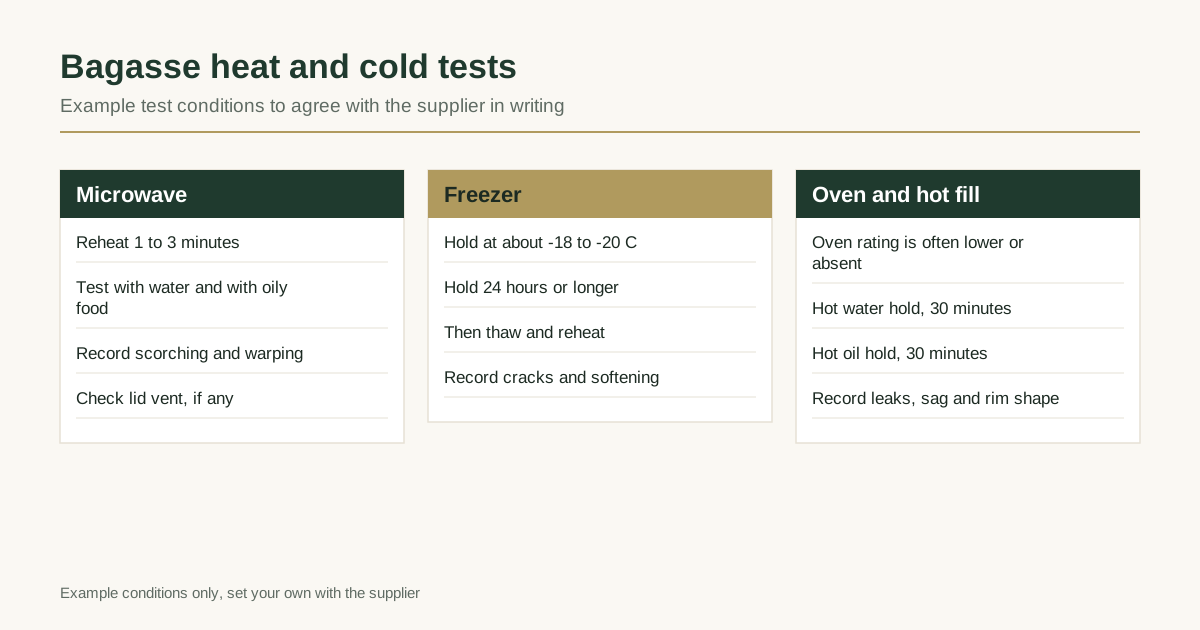
The table shows example conditions. Set your own values from your menu, your serving practice and any limits stated by the supplier.
| Test | Example conditions | What to record | Typical buyer pass criteria |
|---|---|---|---|
| Hot water hold | Fill with hot water, hold about 30 minutes | Leak, sag, rim shape, surface softness | No leak, no loss of shape |
| Hot oil hold | Fill with hot cooking oil or oily sauce, hold about 30 minutes | Oil strike-through on the outside, softening | No visible strike-through, no softening |
| Microwave reheat | Chilled food, reheat 1 to 3 minutes at full power | Surface temperature, scorching, warping, odor | No scorching or deformation |
| Freezer storage | Hold at about minus 18 to minus 20 degrees C for 24 hours or longer | Cracks, delamination, condensation softening | No cracking, usable after thaw |
| Freeze, thaw, reheat | Frozen food through microwave reheat | Same as above | No loss of function |
| Lid fit and stacking | Closed lid after each test | Closure, warp, leak when tilted | Lid still closes and seals |
Repeat each test on at least five pieces, and run the water and oil tests on pieces from different cartons. Pieces from one carton can all share the same weakness or the same strength.
Reading the supplier’s test report
Ask for the report behind each claim and check these points:
- Item and batch. Does the report name your exact item, size and thickness?
- Conditions. What temperature, time and food were used?
- Method. Which method or standard, if any, did the lab follow? Methods commonly cited for fiber products include the Cobb method (ISO 535) for water absorption and a kit test such as TAPPI T 559 for grease resistance. These measure absorption of water and grease through the material, not full microwave behavior.
- Lab. Is the report from an independent laboratory, or an internal check?
- Date. Was it run recently, and does it reflect the current formulation?
A report that tests water absorption at room temperature does not support a microwave claim. A report that tests migration into food simulants at a stated temperature supports a food contact claim, which is a separate topic. Our guide to compostability certificates and food contact tests covers that side.
Common failure modes
- Scorching. Brown or black spots where oily food sits, usually under fatty sauces.
- Warping. A flat plate bowing or a rim lifting after reheating, a sign of uneven density from forming.
- Strike-through. Oil or sauce appearing on the outside surface, which points to a weak barrier additive.
- Sag. A hot, wet base that loses stiffness under weight.
- Cracking in the freezer. Brittle rims, often on thin or low-moisture pieces.
- Condensation softening. A frozen item that goes damp when moved into the warm air and loses stiffness.
If failures appear, ask whether the issue is formulation, weight or press settings. A heavier piece or a revised additive often solves it, at some cost. See how bagasse tableware is made for where each of these variables is set.
How to word the claim on your pack
Print only what you tested, and keep the record:
- Prefer specific wording such as “suitable for microwave reheating, up to 2 minutes” over “microwave safe”.
- Do not print an oven claim unless the supplier gives a written limit supported by a test report.
- State freezer use as storage plus reheat, for example “suitable for freezer storage, reheat in a microwave”.
- If your market regulates packaging claims, check the rules with your compliance advisor before printing.
Keep the test results, the batch number and the sample photos on file for each claim.
Sample requests that make testing easier
Ask the supplier for at least 20 pieces from at least two cartons, plus the matching lid if there is one. Ask for the written weight and thickness so you can compare your measurements. If the item is new, ask for a second round of samples from the production line, not hand-picked pieces.
For pricing effects of heavier, better-barrier pieces, see our breakdown of bagasse packaging cost from Vietnam.
How biopackvn.com fits in
We are a matching service, not a factory and not an agent that manages orders. You send an RFQ, we reply within 24 business hours and we introduce up to 3 Vietnamese manufacturers that suit your item and volume. You work with them directly on samples, tests and price. It is free for buyers, we take no commission and we sign an NDA on request.
We do not verify or confirm any manufacturer’s compostability certificate or test report. Request the originals from the manufacturer and check them with the issuer or the laboratory.
Next step
Include these lines in your RFQ so the first quotes come with test data:
- Item and size: plate, bowl, clamshell or tray, with dimensions and target weight
- Use case: the food, the serving temperature and whether it is reheated, frozen or hot-filled
- Claims you plan to print: for example microwave reheating time and freezer storage
- Documents wanted: test reports for those conditions, plus food contact and certificate documents for the exact item
- Volume: first order and expected annual quantity
See our bagasse tableware sourcing page for standard items, then send your RFQ.
Frequently asked questions
Is bagasse microwave safe?
Many bagasse containers are sold for microwave reheating, usually for a short time, but safety depends on the specific item, the additives and the food. Ask the supplier for its written limit and the test behind it. Then test the item with your own food, because oily and sugary food can overheat the fiber.
Can bagasse go in a conventional oven?
Do not assume so. Many suppliers do not rate bagasse for a conventional oven, and where a limit is given it is usually modest. Fiber can scorch at higher temperatures. Ask for the written temperature and time limit and a test report, and do not print an oven claim without them.
How do I test bagasse for freezer use?
Fill the container with the product, seal it as sold and hold it at your real storage temperature, often around minus 18 to minus 20 degrees C, for a period at least as long as your shelf life. Then thaw and reheat, and record cracks, softening, delamination and any leak.
BioPack VN is a matching service, not a manufacturer. Figures above are typical market ranges for planning, not quotes, and we do not confirm any manufacturer's certificates. Send an RFQ to be introduced to up to 3 Vietnamese manufacturers within 24 business hours.