How Bagasse Tableware Is Made: Pulping, Molding and Pressing Step by Step
Key points
- Bagasse tableware starts as the fiber left after sugarcane is crushed, which is pulped in water, formed on a mesh mold and pressed in a heated metal mold.
- The additive added at the pulping stage sets water and oil resistance, so it matters as much as the press for how a plate behaves with food.
- Four numbers describe most quality problems: moisture of the incoming fiber, piece weight, wall thickness and the temperature of the press.
A bagasse plate looks simple, but it passes through six or seven controlled steps before it reaches a carton. Each step leaves a trace that a buyer can check: a color shift from pulping, a rough edge from trimming, a soft spot from a cold press. Knowing the sequence makes sample reviews and factory questions much more precise.
This guide follows the process from sugar mill to packed carton, as it is typically run in molded fiber plants. Details differ between factories, so treat the figures below as indicative ranges and confirm them with each supplier.
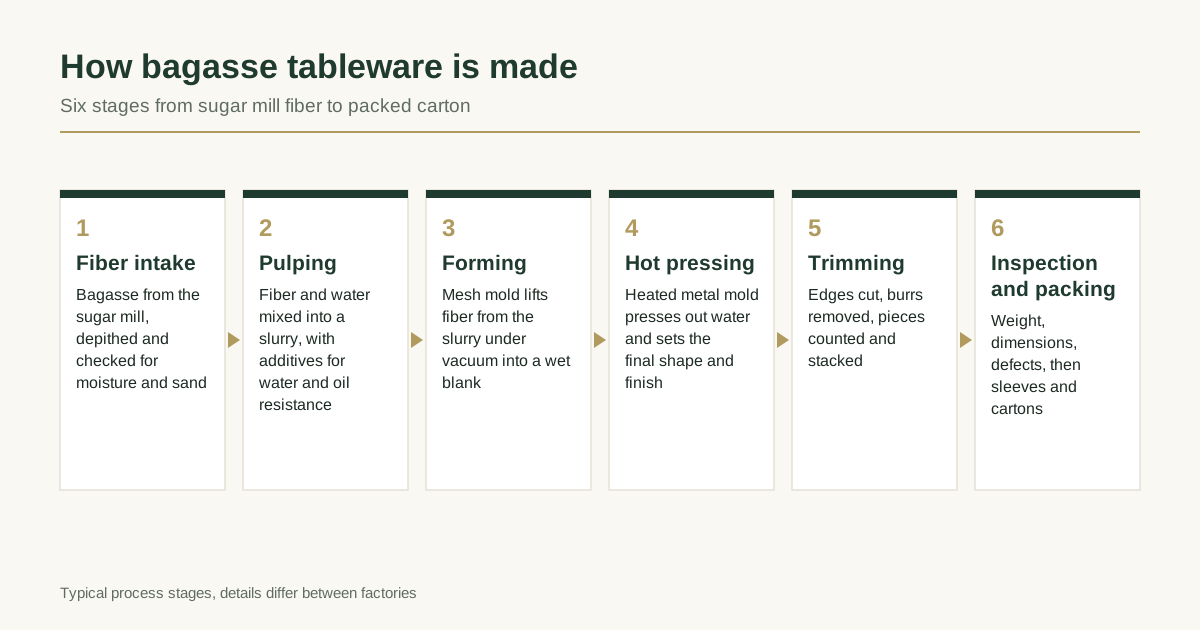
Step 1: Fiber intake
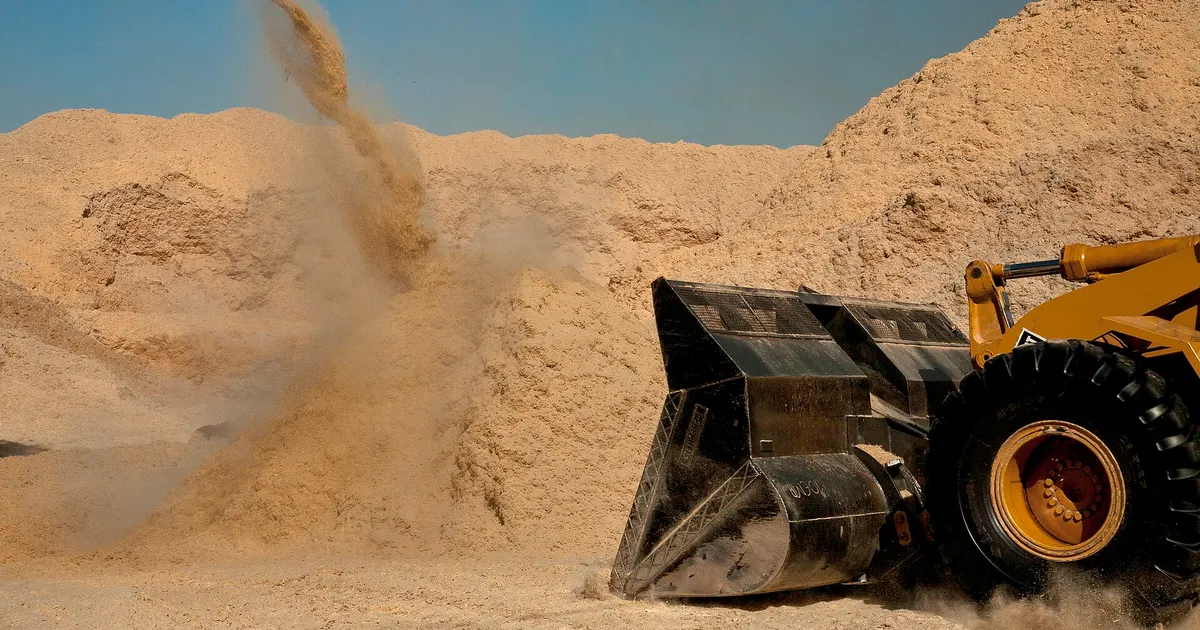
Bagasse is the fibrous material that remains after sugarcane stalks are crushed and the juice is taken for sugar. Sugar mills produce it in large volumes and burn much of it as boiler fuel, so tableware factories compete with the mill’s own energy needs for supply. Fiber usually reaches the plant as a damp bulk material or in compressed bales.
Raw fiber contains pith, the soft inner tissue of the cane, along with sand and small stalk fragments. Many factories remove most of the pith (depithing) because it weakens the finished piece and shows up as dark specks. At intake a careful plant checks moisture, looks for sand and sorts out contaminated lots. Moisture matters because wet stored fiber can mold, and mold risk carries through to the finished product.
Questions to ask: where does the fiber come from, how is it stored, and is it depithed? A plant that stores bagasse under cover on a hard floor has fewer contamination problems than one that stores it in the open on soil.
Step 2: Pulping and additives
The fiber is mixed with water in a pulper, which breaks the bundles apart into a slurry. Pulp consistency (the share of fiber in the water) is kept low, so the mix flows and pumps easily. Some plants refine the pulp further, and some blend in a second fiber such as bamboo to adjust strength or whiteness.
Additives go in at this stage, and they matter a great deal:
- Water resistance. Sizing agents such as alkyl ketene dimer (AKD) or wax emulsions slow water absorption.
- Oil resistance. Grease barriers keep fatty foods from soaking through. Older barrier chemistry was fluorinated, which is why PFAS-free is now a standard line in buyer specifications. Our guide to PFAS-free molded fiber packaging covers what to ask for.
- Bleaching. White tableware is bleached, and natural beige tableware is not. Bleaching method and any residues should be stated by the supplier.
The additive package is the least visible part of the product and the one most likely to differ between a cheap plate and a good one.
Step 3: Forming
A forming mold, a metal tool covered with fine mesh and shaped like the final piece, dips into the slurry. A vacuum draws water through the mesh and fiber deposits on the surface. When the mold lifts out, it carries a wet blank, a fragile fiber shell that is mostly water.
Forming controls thickness. A longer dip and stronger vacuum build a thicker wall. Uneven suction or a clogged mesh produces thin spots, and thin spots are where a plate later fails under hot food. The blank is then transferred, typically by a transfer mold, to the hot press.
Step 4: Hot pressing
In the hot press the wet blank is squeezed between a heated upper and lower metal mold. Heat and pressure do three jobs at once: they remove most of the remaining water, bond the fibers together and set the surface finish. Temperatures commonly fall in the range of about 150 to 220 degrees C depending on the plant and the item, and a cycle often lasts from tens of seconds to a couple of minutes.
This is where a plate gets its smooth, dense surface. Temperature, pressure and time have to be balanced. A cold or short press leaves a soft, damp piece with poor strength and a higher mold risk later. An overheated press can scorch the surface and raise brittleness. For a comparison of this route with the lower-cost route that skips hot pressing, see our guide on wet press vs dry press molded fiber.
| Parameter | Typical range | What goes wrong outside it |
|---|---|---|
| Press temperature | About 150 to 220 degrees C | Soft pieces (too low) or scorching (too high) |
| Press cycle | Tens of seconds to about 2 minutes | Residual moisture (too short) |
| Wall thickness | Often around 0.8 to 1.5 mm for plates | Flexing (too thin), weight and cost (too thick) |
| Piece moisture after pressing | Low single digits to about 10 percent | Mold in the carton (too high) |
Step 5: Trimming and finishing
A pressed piece has a rough rim. A trimming die, built into the press line or run as a separate step, cuts the edge to final size. Burrs and loose fiber at the rim are the most common visible defect in a poorly trimmed plate.
Finished pieces are counted, stacked and often passed under ultraviolet light or ozone to reduce surface microbes before packing. Ask whether this step exists and whether the plant keeps records, because hygiene claims carry weight with food-service buyers.
Step 6: Inspection and packing
Inspection checks weight, dimensions, color, rim quality and visible defects such as holes, cracks and thin spots. Then pieces go into sleeves, cartons and sometimes shrink wrap. Bagasse tableware is light and bulky, so a 20 ft container fills by volume well before it reaches its weight limit. We cover how that shapes minimum orders in our guide to MOQ and lead time.
Packing deserves as much attention as pressing. A carton stacked in humid conditions can absorb water before it ever leaves the factory, and cartons packed with still-warm pieces trap moisture.
What this means when you review a sample
You can read the process back from a finished plate:
- Color. A uniform cream or white points to consistent pulp and bleaching. Dark specks usually mean pith or contaminants.
- Weight. Weigh ten pieces on a scale and note the spread. Large spread means poor control at forming.
- Surface. A smooth, dense surface suggests an adequate press. A fuzzy or soft surface suggests a cold or short press.
- Rim. Clean, even edges indicate sharp trimming dies and good alignment.
- Smell and feel. A damp or musty smell on a new carton is a warning sign about drying and storage.
Then test with your actual food. A plate that passes a water test may still fail with hot, oily sauce, which is why we recommend the checks in our overview of microwave, oven and freezer tests.
Questions to put in the RFQ
- Fiber source, blend (bagasse only or mixed with another fiber) and bleached or natural
- Additive package for water and oil resistance, and PFAS status with a test report
- Target weight per piece, wall thickness and tolerance
- Press route (hot press or not) and any secondary shaping step
- Moisture target at packing and how it is checked
- Compostability certificates and food contact test reports for the exact item
We do not verify or confirm any manufacturer’s compostability certificate, whether BPI, TUV Austria OK compost, ASTM D6400 or EN 13432. Request the original documents and check them with the issuer before you order. Our guide to compostability certificates and food contact tests explains what to ask for.
See also: our reference page on bagasse as a packaging material, from fibre source to barriers and standards.
How biopackvn.com fits in
We are a matching service, not a factory and not an agent that manages orders. You send an RFQ, we reply within 24 business hours and we introduce up to 3 Vietnamese manufacturers that suit your item and volume. You then work with them directly. It is free for buyers, we take no commission and we sign an NDA on request.
If you already know the item you need, our bagasse tableware sourcing page lists the standard range. When you are ready, send your RFQ with the item, size, target weight and annual volume.
Frequently asked questions
What is bagasse tableware made of?
Mainly sugarcane bagasse, the fibrous residue left after juice is extracted from the cane, plus water and small amounts of additives that give water and oil resistance. Some factories blend in other plant fibers such as bamboo. Ask for the fiber blend in writing, because it affects strength, color and certificates.
Is bagasse tableware made with glue or plastic?
Standard bagasse pieces are held together by fiber bonding under heat and pressure, not by glue. Barrier additives are used for water and oil resistance, and the exact chemistry differs between factories. If your market restricts PFAS, say so in the RFQ and ask for an independent test report.
Why do two bagasse plates of the same size feel different?
Weight per piece, wall thickness and press temperature differ between factories and even between production lines. A heavier plate usually flexes less and costs more. Put a target weight and a tolerance in the specification, and check it on a scale during inspection.
BioPack VN is a matching service, not a manufacturer. Figures above are typical market ranges for planning, not quotes, and we do not confirm any manufacturer's certificates. Send an RFQ to be introduced to up to 3 Vietnamese manufacturers within 24 business hours.