Coconut Shell and Coir Products for Tableware and Packaging: A Wholesale Buyer's Guide
Key points
- Coconut shell bowls are hand-finished reusable items, so size, shape and shell pattern vary, and a grading sheet with size bands is the main control.
- The finish is the food-contact question: ask what oil or lacquer is used and what test documents exist for it.
- Moisture and mold are the main transit risk, so set a moisture limit and agree packing for sea freight.
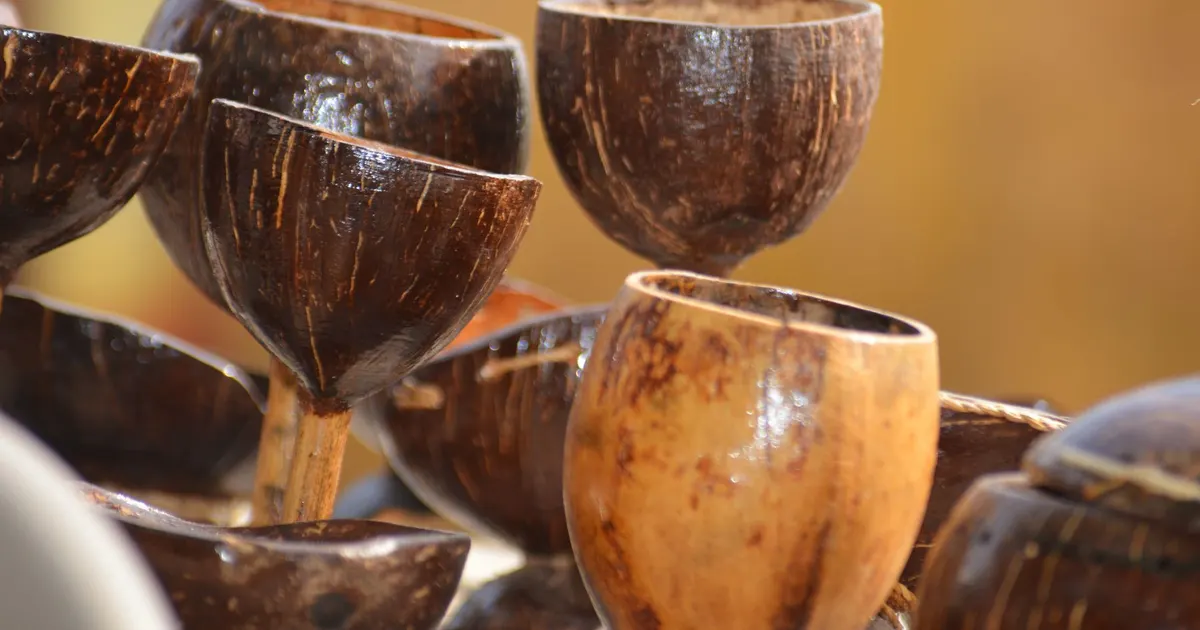
A coconut bowl is the opposite of a molded fiber plate. No two are exactly the same, it is made by hand, and it is sold to be used many times. A buyer who orders them the way they order plates, with a drawing and a tolerance, is in for surprises. A buyer who understands how they are made can write a specification that works.
This guide covers coconut shell bowls and a short look at coir (coconut husk fiber) products, how they are made, how to grade them, which finish and hygiene questions matter and how to plan a first order. Vietnam is a large coconut producer, and the Mekong Delta province of Ben Tre is a well-known centre of the coconut industry, so shells and fiber are locally available. Figures below are typical ranges to confirm with each supplier.
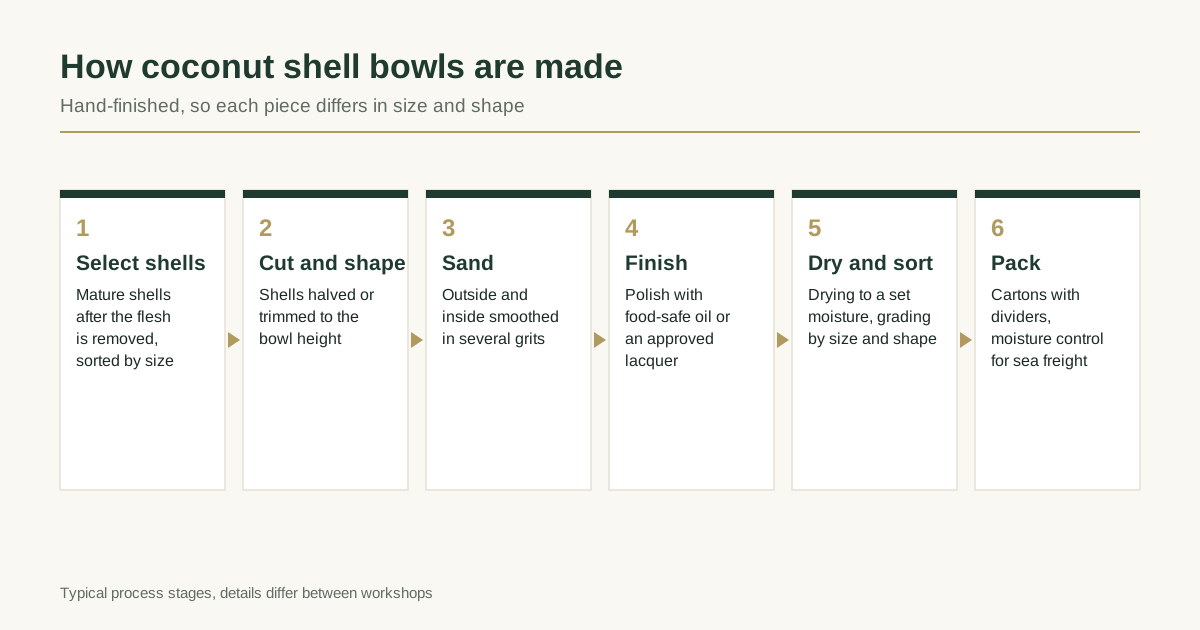
How a coconut shell bowl is made
The raw material is the hard shell of a mature coconut, left after the flesh is used for food or oil. Workshops typically follow these steps:
- Selecting shells. Shells are sorted by size and shape, and cracked or heavily scarred ones are set aside.
- Cutting and shaping. Shells are halved or trimmed to the height of a bowl or cup. Some products are cut to leave a lip, a foot or a flat base.
- Sanding. The outside and inside are sanded through several grits until smooth. Some bowls keep a rougher natural outer surface.
- Finishing. Pieces are polished and finished, usually with a food-safe oil or a lacquer, which also affects the look.
- Drying and sorting. Pieces are dried and graded by size, shape, color and surface.
- Packing. Cartons use dividers or wrapping to avoid chipping, and moisture control for export.
Because shells are natural, the bowls differ in capacity, wall thickness, color and grain. That variation is the product’s selling point, and it is also its main specification challenge.
Size, grade and tolerance
Define sizes in bands, not in a single dimension. A bowl might be sold as a diameter band, a height band and a capacity band, with a weight range. Tolerance is much wider than for pressed items.
| Specification item | How to set it | Why |
|---|---|---|
| Diameter band | Min and max in cm | Shells vary in size |
| Height band | Min and max in cm | Cut depth varies |
| Capacity band | Min and max in ml, by water fill | Customers use bowls for portions |
| Weight range | Min and max in grams | A rough check of wall thickness |
| Surface grade | Photos of accepted and rejected pieces | Natural variation |
| Inside finish | Smooth to touch, no splinters | Safety and appearance |
| Cracks | None accepted | Strength and hygiene |
A grading sheet with photos is the main tool. Ask for a set of 20 or more pieces from a normal run, sort them into grades and keep the set as your reference, as we describe for palm leaf plates in our guide to areca leaf plate grades.
Finish and food contact
The finish is the food-contact question. A bare shell is hard and generally inert, but sanding dust, polishing compounds, oils and lacquers all touch the food side if used inside.
Ask the supplier:
- What finish is used on the inside surface and on the outside?
- Is the finish a food-grade oil, a wax or a lacquer, and what is its composition?
- What test documents exist for the finish, and for which market?
- How is the bowl cleaned before packing?
- Is there a care instruction for end users, such as hand washing and re-oiling?
Do not assume a lacquer is food safe. Request a declaration or test report that matches your destination market’s food contact rules, and check the report date and the laboratory. We do not verify or confirm any manufacturer’s documents, so request originals and check them with the issuer. Our guide to compostability certificates and food contact tests lists what to request.
Care instructions matter for reusable items: most coconut bowls are not dishwasher items, and soaking or long heat can damage the finish. Ask for supplier guidance on microwave and hot liquids and state a conservative position on the pack.
Moisture, mold and shipping
Shells hold moisture, and a bowl packed damp can grow mold in a closed carton during 20 to 30 days of sea freight. Treat this like palm leaf:
- Set a maximum moisture content at packing and a way to measure it.
- Ask how pieces are dried and for how long.
- Use liners, desiccants or sealed inner bags in cartons.
- If wooden pallets are used, ask for heat-treated pallets marked under ISPM 15, the international standard for wood packaging.
- Ask your customs broker whether plant-based goods need any phytosanitary documents for your destination.
Coir products in brief
Coir is the fiber from the husk of the coconut. The Mekong Delta supplies large volumes. Typical coir products include fiber mats and rolls, erosion-control netting, planting pots and growing media. In packaging, coir fiber is used in cushioning pads and padding in some products. These are mostly non-food applications.
Coir products are specified by fiber length, density, moisture and weight per square meter, and they are rated by the use, not by food contact. If you plan to use coir as packaging cushioning, ask for a sample at the density you need and test it with your product. We cover other cushioning options in our guide to molded pulp protective packaging.
MOQ, price and lead time
Hand-finished items often allow lower minimums than machine-pressed items. A few thousand pieces per size is a typical starting point, though it depends on the workshop and finish. Price depends on size, grade, finish and wall thickness, and bigger bowls cost disproportionately more because fewer shells are large enough.
Lead times of 30 to 45 days for standard runs are common, longer if a custom shape, engraving or color treatment is added. Always confirm monthly capacity, since hand work cannot be scaled in a few days. For how first orders are planned, see our guide to MOQ and lead time.
Typical uses
| Use | Typical product | Note |
|---|---|---|
| Restaurants and cafes | Bowls for desserts and bowls for grain dishes | Grading and finish matter for appearance |
| Hotels and resorts | Cups, bowls, spoons | Reusable, branding by engraving |
| Retail | Single bowls and gift sets | Packaging and care card |
| Events | Display and serving | Reusable, higher price |
How biopackvn.com fits in
We are a matching service, not a factory and not an agent that manages orders. You send an RFQ, we reply within 24 business hours and we introduce up to 3 Vietnamese manufacturers that suit your item and volume. You then deal with them directly on samples, grading and price. It is free for buyers, we take no commission and we sign an NDA on request.
Next step
A useful RFQ for coconut shell products includes:
- Items and sizes: diameter, height and capacity bands, with reference photos
- Finish: oil, lacquer or natural, and any engraving
- Grade: photos of accepted and rejected appearance
- Quantity: first order and expected annual volume by size
- Documents: food contact test reports for the finish and your market
Browse our compostable packaging page for related materials and then send your RFQ.
Frequently asked questions
Are coconut bowls single-use or reusable?
Mostly reusable. They are hand-finished from mature coconut shells and priced as durable tableware for restaurants, cafes, hotels and retail, not as disposable items. That changes the specification: grading, finish and care instructions matter more than stacking speed or lid fit.
What finish is used on coconut bowls?
Most are polished and finished with a food-safe oil, such as coconut oil, or with a lacquer. Finishes differ by workshop, so ask for the finish in writing and for test documents that match your market's food contact rules. Do not assume a lacquer is food safe.
What is the minimum order for coconut bowls?
Hand production usually allows lower minimums than machine-pressed items, often a few thousand pieces per size, but this varies by workshop and finish. Ask for a quote at your quantity and confirm how sizes and grades are split within a carton.
BioPack VN is a matching service, not a manufacturer. Figures above are typical market ranges for planning, not quotes, and we do not confirm any manufacturer's certificates. Send an RFQ to be introduced to up to 3 Vietnamese manufacturers within 24 business hours.