CPLA vs PLA Cutlery: Heat Resistance, Feel and What End-of-Life Claims Hold Up
Key points
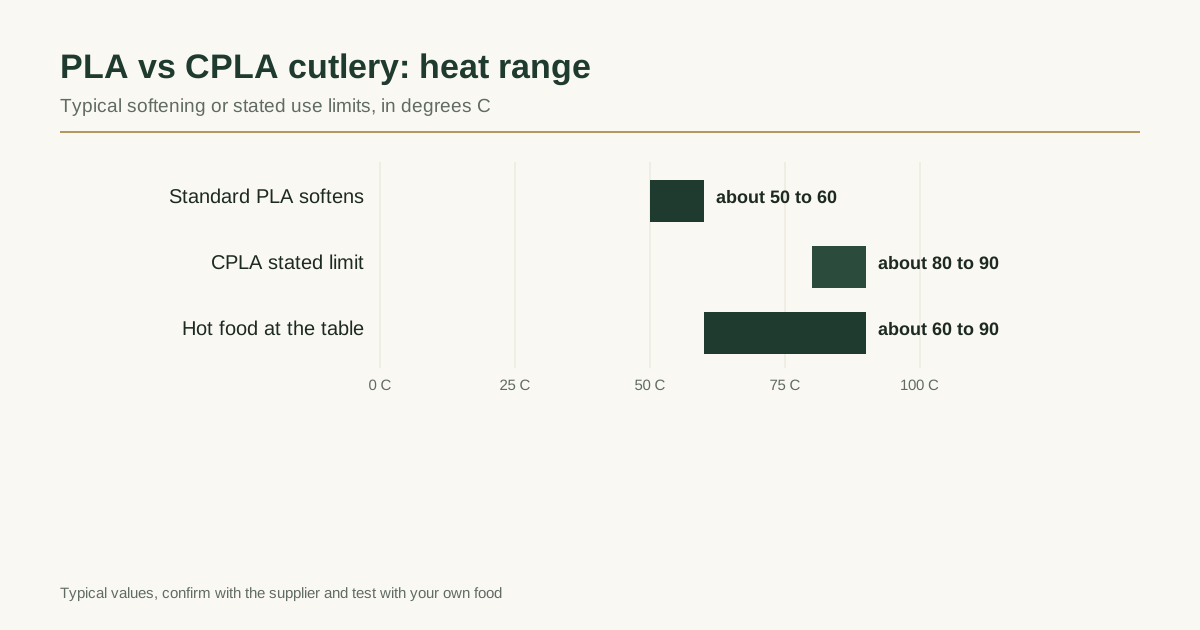
- Standard PLA cutlery softens at roughly 50 to 60 degrees C, and CPLA is crystallized and filled to reach a stated limit of roughly 80 to 90 degrees C.
- Both are bioplastics that need industrial composting, and a certificate applies to the exact item, so a claim on your pack needs the matching document.
- In the EU, bioplastic cutlery is still plastic cutlery under the Single-Use Plastics Directive, so check the rules for your market before you buy.
Two fork samples arrive in the same white. One bends in a cup of hot noodles and the other holds. The pair look identical in a catalog, but one is PLA and the other CPLA, and the difference is the single most common complaint in plant-based cutlery.
This guide compares the two on the points a buyer actually pays for: heat resistance, stiffness, look and feel, price and the end-of-life claims you can safely print. It is written for buyers who may also consider wood or bamboo cutlery, which we cover in our guide to wooden cutlery specifications. Figures are typical ranges to confirm with the manufacturer.
What PLA and CPLA are
PLA (polylactic acid) is a thermoplastic made from lactic acid, which is fermented from plant sugars or starch such as corn, sugarcane or cassava. It is injection molded into cutlery, and it is a plastic, even though the feedstock is plant based. Most PLA resin is produced by a small number of resin makers, and converters, including those in Vietnam, typically buy resin and mold the finished cutlery.
CPLA is crystallized PLA. The polymer is compounded with a mineral filler such as chalk or talc and heat treated, or processed in a way that raises crystallinity. The result stays rigid at higher temperatures. Exact formulations differ by maker, and they matter for certificates.
Heat resistance
Standard PLA has a glass transition temperature around 55 to 60 degrees C. Above that, it softens, so a fork left in hot soup, noodles or tea can bend. CPLA is made to resist that: typical stated limits are around 80 to 90 degrees C, though real behavior depends on the formulation, the thickness of the piece and the time it spends in the hot food.
| Factor | PLA | CPLA |
|---|---|---|
| Softening onset | Roughly 50 to 60 degrees C | Roughly 80 to 90 degrees C stated |
| Hot soup or noodles | Likely to bend | Usually holds for a meal |
| Hot beverage stirrers | Marginal | Usually acceptable |
| Reuse or dishwasher | Not designed for it | Not designed for it |
| Car or container heat in summer | Can warp | Better, still test it |
Warping in a hot container is a shipping risk as well as a service risk. A container in summer sun can exceed 50 degrees C inside, which can distort PLA pieces in cartons. Ask the supplier about transport temperature and packing.
Look and feel
PLA is often glossy and can be clear, white or colored. CPLA is usually opaque and matte, typically white or beige, with a slightly chalky feel from the filler. CPLA is stiffer, and stiffness has a cost: it is often more brittle, so thin tines or the tips of spoons can snap under load. Compare samples on tines, knife serration and spoon bowl depth, not only on flat color.
Price and minimum orders
CPLA usually costs more than PLA because of the added process and compounding. Injection molded cutlery needs molds, and a stock design avoids tooling cost. Minimums depend on the factory, the color and the number of items per carton, so ask for a quote at your own quantity. For how orders are built, see our guide to MOQ and lead time.
What happens at end of life
PLA and CPLA are designed for industrial composting, where sustained heat, moisture and microbial activity break them down. In general, they do not break down in a home compost pile, in landfill or in the ocean at useful speeds. Many municipal composting programs do not accept PLA, either because of local rules or because it is hard to tell apart from conventional plastic at sorting. Before you promise a customer that a fork is compostable, check what facilities actually accept it in your sales area.
Certification routes include BPI for the US (based on ASTM D6400) and TUV Austria OK compost INDUSTRIAL or other schemes based on EN 13432 in Europe. A certificate covers a specific item, thickness and formulation, so a CPLA fork is not covered by a PLA fork’s certificate, and a different color may need separate coverage.
We do not verify or confirm any manufacturer’s compostability certificate. Request the original and check it in the issuer’s public database. Our guide to compostability certificates and food contact tests lists what to ask.
Claims you can and cannot make
- Compostable. Only with a certificate for the exact item, and a local route to composting for it. Some places restrict the word without certification.
- Biodegradable. Rules vary and several regions limit unqualified use. Prefer a standard-based claim over a general one.
- Bio-based. Refers to the feedstock, not to the end of life. It does not mean compostable.
- Plastic-free. Not correct for PLA or CPLA, because both are plastics.
EU rules: bioplastic cutlery is still plastic
The EU Single-Use Plastics Directive restricts plastic cutlery, and it does not exempt bio-based or biodegradable plastics. That means PLA and CPLA cutlery fall under the restriction, and national laws implement it differently. If you sell into the EU, wood, bamboo or fiber cutlery is the safer assumption, and you should check the current position with a compliance advisor. We explain the directive for packaging buyers in our guide to the EU Single-Use Plastics Directive.
Other markets are moving in similar directions, and some US states and cities restrict foodservice plastics too, so check the local rules for each destination.
Choosing: a simple decision path
| Situation | Better choice |
|---|---|
| Cold salads, desserts, short use | PLA may be enough |
| Hot food, soup, noodles | CPLA, or wood or bamboo |
| EU market | Check the directive first, consider wood, bamboo or fiber |
| Strong compost claim needed | Certified item with a local composting route |
| Lowest price | PLA, if the use is cold and short |
Testing before you buy
- Hot hold. Place the cutlery in the hottest food on your menu for the full meal time, and check for bending.
- Load. Press tines into a firm food, such as chilled pasta, and flex a knife on a plate.
- Transport. Ask for a heat soak test of a carton at the temperature a summer container can reach.
- Documents. Collect the certificate, the resin supplier’s data sheet and a composition statement.
Common mistakes with plant-based cutlery
- Judging heat resistance on a dry sample. Test in your hottest food for the whole meal.
- Assuming CPLA is covered by a PLA certificate. Each formulation needs its own coverage.
- Printing “compostable” with no local route. Check which facilities accept the item.
- Ignoring summer container temperatures. Warped cutlery is a rejected shipment.
- Treating bioplastic as exempt from plastic rules. In the EU it is not.
See also: our reference page on PLA in packaging, which covers grades, heat limits and food contact rules beyond cutlery.
How biopackvn.com fits in
We are a matching service, not a factory and not an agent that manages orders. You send an RFQ, we reply within 24 business hours and we introduce up to 3 Vietnamese manufacturers that suit your item and volume. You then deal with them directly. It is free for buyers, we take no commission and we sign an NDA on request.
Next step
A useful RFQ for cutlery includes:
- Material: PLA, CPLA, wood, bamboo or open to advice
- Items: fork, knife, spoon, sets and any wrapping
- Use: food type, serving temperature and hold time
- Market: destination country and any restrictions you know of
- Documents: certificates and composition statements for the exact item
See our compostable packaging sourcing page and then send your RFQ.
Frequently asked questions
What is the difference between PLA and CPLA?
PLA is polylactic acid, a bioplastic made from fermented plant sugars. CPLA is crystallized PLA, usually compounded with mineral filler and heat treated so it stays rigid at higher temperatures. CPLA is typically opaque and stiffer, with a higher stated heat limit, and it usually costs more.
Is CPLA cutlery compostable?
It can be certified for industrial composting, but the certificate must cover the exact item and formulation. PLA and CPLA need the heat and time of an industrial composting facility and do not generally break down in a home compost pile or in landfill. Request the original certificate and check it with the issuer.
Is PLA cutlery allowed under the EU single-use plastics rules?
The EU Single-Use Plastics Directive restricts plastic cutlery and does not exempt bio-based or biodegradable plastics, so PLA and CPLA cutlery are treated as plastic cutlery. Rules and national implementation differ, so check the current position for your market with your compliance advisor.
BioPack VN is a matching service, not a manufacturer. Figures above are typical market ranges for planning, not quotes, and we do not confirm any manufacturer's certificates. Send an RFQ to be introduced to up to 3 Vietnamese manufacturers within 24 business hours.