Bagasse Clamshells for Food Delivery: Sizes, Compartments and Leak Tests
Key points
- Food delivery tests a clamshell with tilt, shake, stacking and trapped steam, so test it with your real menu, not with water on a bench.
- The hinge and the latch fail first, and both are set by the mold design and the fiber weight, so check them on production samples.
- Specify size by water-fill capacity and compartment layout, and agree weight, lid fit and vent features in writing.
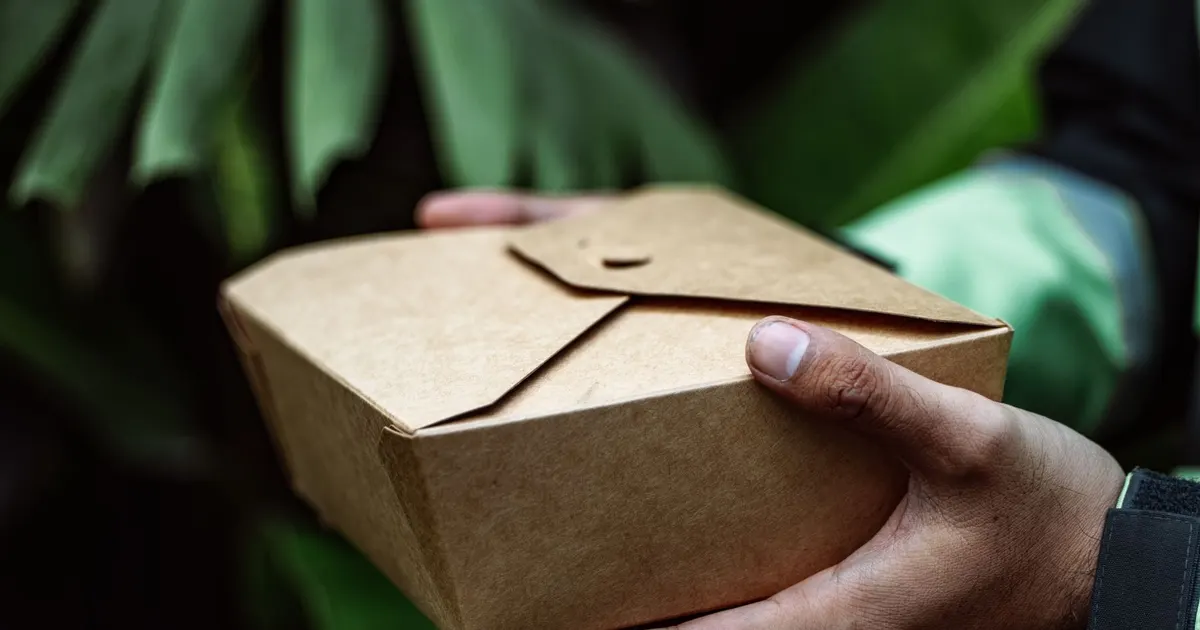
A clamshell is the most punished item in food delivery. It is closed by a packer in a hurry, carried by a bag handle, tilted in a basket, stacked under other bags and opened by a customer who expects hot food and no sauce on the bag. A good clamshell survives that journey. A poor one makes it into a refund report.
This guide covers bagasse clamshells for delivery: sizes and compartments, the features that fail, a test plan, and what to put in an RFQ. For the materials background, see our guide to how bagasse tableware is made. Figures below are typical ranges to confirm with the manufacturer.
Sizes and compartments
Most factories offer a set of stock clamshells made on existing molds, usually as square or rectangular boxes with a hinged lid and a latch. They come as one, two or three compartments.
| Format | Typical use | Notes |
|---|---|---|
| Small square, one compartment | Sides, desserts, small meals | Shallow, light |
| Medium square, one compartment | Rice dishes, noodles, sandwiches | Common stock size |
| Large square, one or three compartments | Combo meals, plates with sauces | Divider walls add stiffness |
| Rectangular, two compartments | Mains with a side | Depth varies by mold |
| Burger and sandwich box | Burgers, wraps | Taller lid |
Specify size in three ways: the outside footprint in millimeters, the depth, and the capacity by water fill in milliliters. Capacity depends on depth, wall thickness and where the fill line is, so a size name like “8 inch” is not enough. Ask each factory for a technical drawing and the weight per piece.
What fails in delivery
Four features decide whether a clamshell holds up:
- The hinge. A molded fiber hinge is a thin strip that flexes at each opening. Weak or over-dry hinges crack after one or two openings, or when the lid is closed hard.
- The latch. A tab or lock holds the lid shut. Poor latch geometry pops open when the box is squeezed or stacked.
- Lid fit. A lid that sits loose leaks and lets steam escape unevenly. A lid that sits too tight tears or warps.
- Wall and base thickness. Thin bases sag under heavy food and weep oil.
All four trace back to the mold design and the weight of the piece. A custom tool lets you correct them, as described in our guide to custom molds for bagasse packaging. Stock shapes already have a track record, which is a reason to start with them.
Steam, heat and crispness
A closed clamshell traps steam. In fiber that is somewhat insulating, steam condenses on the inside of the lid and drips onto the food, which softens fried items and pastries. Strategies include:
- Vents. Small holes or gaps in the lid release steam. Too many vents let heat escape and sauce spill.
- Compartments. Separating crisp items from sauce helps.
- Liners or paper. An inner sheet can absorb moisture, though it adds cost and a second material.
- Delivery time. The longer the trip, the more the box matters. Test with your longest delivery window.
Fiber is not a perfect insulator, and a clamshell will not hold temperature like a foam box. Test your menu and set expectations on the menu page.
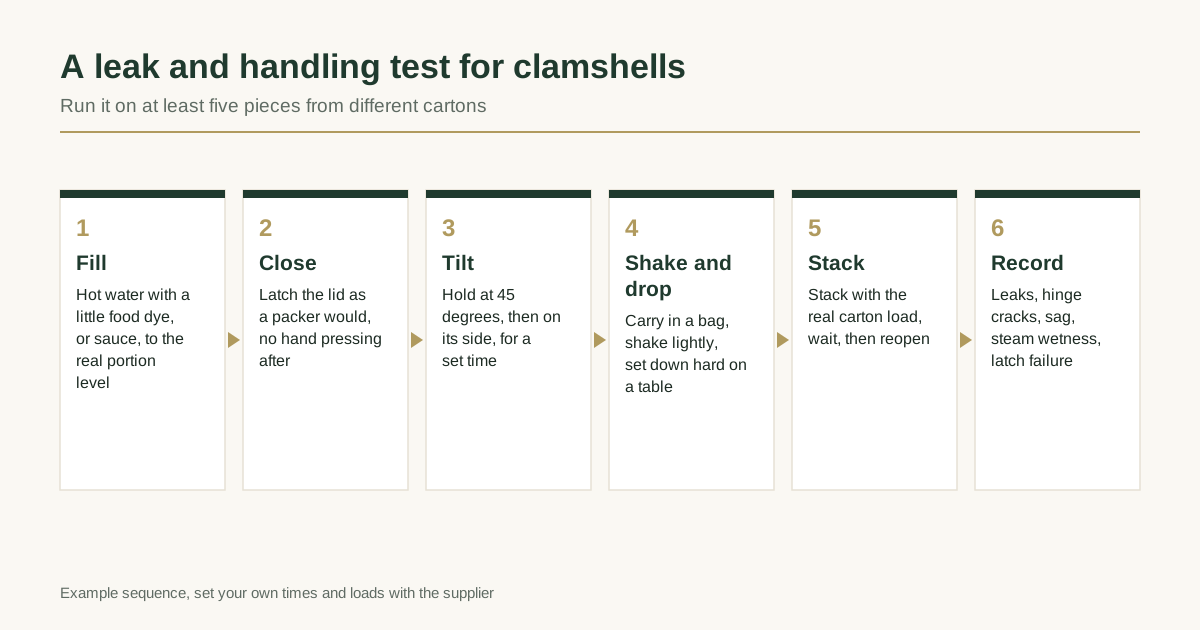
A test plan
The table shows an example plan. Set times and loads from your own delivery pattern.
| Test | Example method | What to record |
|---|---|---|
| Leak, still | Fill to the portion line with hot water and dye, close, wait | Weeping at hinge, seams, base |
| Leak, tilted | Hold closed box at 45 degrees, then on its side | Leaks at lid edge and latch |
| Shake and drop | Carry in a bag, shake lightly, set down hard | Latch opens, cracks |
| Stack | Stack under a realistic load for the delivery time | Sag, crushing, latch pop |
| Hinge cycle | Open and close ten times | Hinge cracks |
| Hot food hold | Real food at serving temperature, 30 to 60 minutes | Softening, oil strike-through, steam wetness |
| Reheat | Microwave test if you will claim it | Warping, scorching |
Repeat on at least five pieces from different cartons. For heat and cold claims, see our guide to microwave, oven and freezer tests.
Specifying the clamshell
A one-page specification should include:
- Item and layout: footprint, depth, number of compartments, drawing reference
- Capacity: water-fill capacity in milliliters per compartment
- Weight: target per piece and tolerance, measured on a scale
- Fiber and color: natural or bleached, and any blend
- Lid and latch: fit tolerance, vent features and the number of open-close cycles it must survive
- Barrier: water and oil resistance requirements, and PFAS-free if required
- Packing: pieces per sleeve and per carton, carton size and weight
- Documents: food contact tests and any certificate for the exact item
For piece weight and its link to price, see our breakdown of bagasse packaging cost from Vietnam.
Food contact and compostability
Clamshells touch hot, oily food, so barrier chemistry matters. Ask for PFAS-free documentation, backed by an independent test report, if your market requires it. Our guide to PFAS-free molded fiber packaging covers what to request.
We do not verify or confirm any manufacturer’s compostability certificate (BPI, TUV Austria OK compost, ASTM D6400 or EN 13432). Request the original and check it with the issuer. Any certificate covers a specific item, and adding print, labels or an inner liner can change the scope.
Inspection and packing
Before shipment, inspect for cracks at the hinge, burrs, thin spots and wet or soft pieces, and check weight and lid fit on a sample. See our guide to pre-shipment inspection and AQL. Clamshells nest, so ask how stacks are sleeved and cartons loaded, since crushed stacks mean unusable boxes.
Common mistakes with delivery clamshells
- Testing with water only. Hot, oily sauce and steam behave differently from water, so test with the real menu.
- Choosing by name, not capacity. Two boxes called “8 inch” can hold very different volumes, so compare water-fill capacity.
- Ignoring the packer. A latch that needs two hands slows a busy kitchen, so let your packing staff try the sample.
- Approving a hand-picked sample. Ask for pieces drawn at random from a production carton, and weigh them.
- Forgetting the bag. Clamshells are stacked and carried in delivery bags, so test them in the bag you use.
How biopackvn.com fits in
We are a matching service, not a factory and not an agent that manages orders. You send an RFQ, we reply within 24 business hours and we introduce up to 3 Vietnamese manufacturers that suit your item and volume. You then deal with them directly on samples, testing and price. It is free for buyers, we take no commission and we sign an NDA on request.
Next step
A useful RFQ for clamshells includes:
- Layout and size: footprint, depth, compartments and capacity by water fill
- Food and delivery: menu items, serving temperature and longest delivery time
- Features: vents, latch type, branding by embossing
- Quantity: first order and expected annual volume
- Documents: PFAS status, food-contact tests and certificates for the exact item
See our bagasse tableware sourcing page for stock items and then send your RFQ.
Frequently asked questions
What sizes do bagasse clamshells come in?
Common footprints are small, medium and large squares and rectangles, often sold with one, two or three compartments. Depth changes capacity a lot, so specify capacity by water fill in milliliters, with the outside dimensions, and ask for a drawing. Factories usually offer stock shapes before a custom mold is needed.
Will a bagasse clamshell leak?
It can, especially with hot, thin sauces or loose-fitting lids. Leaks come from lid fit, thin walls and cracks at the hinge. Test with the real food at serving temperature, tilt and shake the closed box and keep the test record. A tighter fit often means a heavier piece or a revised mold.
Do bagasse clamshells keep food hot and crisp?
Molded fiber insulates somewhat, but steam is trapped under a closed lid, which can soften fried food. Ask about vent holes or vent gaps, and test with your own menu over the real delivery time. Wrapping bags and sealing choices also change how steam builds.
BioPack VN is a matching service, not a manufacturer. Figures above are typical market ranges for planning, not quotes, and we do not confirm any manufacturer's certificates. Send an RFQ to be introduced to up to 3 Vietnamese manufacturers within 24 business hours.