Compostable Tableware for Airlines and Hotels: Buyer Specs, Limits and Claims
Key points
- Airline caterers care about weight, trolley fit, chilled storage and galley reheating, and hotels care about look, feel and matching cups, lids and cutlery.
- International airline catering waste is often not allowed to be composted, so a compostable claim may add no end-of-life benefit on board.
- Write the tests, the oven or microwave limits and the documents into the order, and check any certificate for the exact item with the issuer.
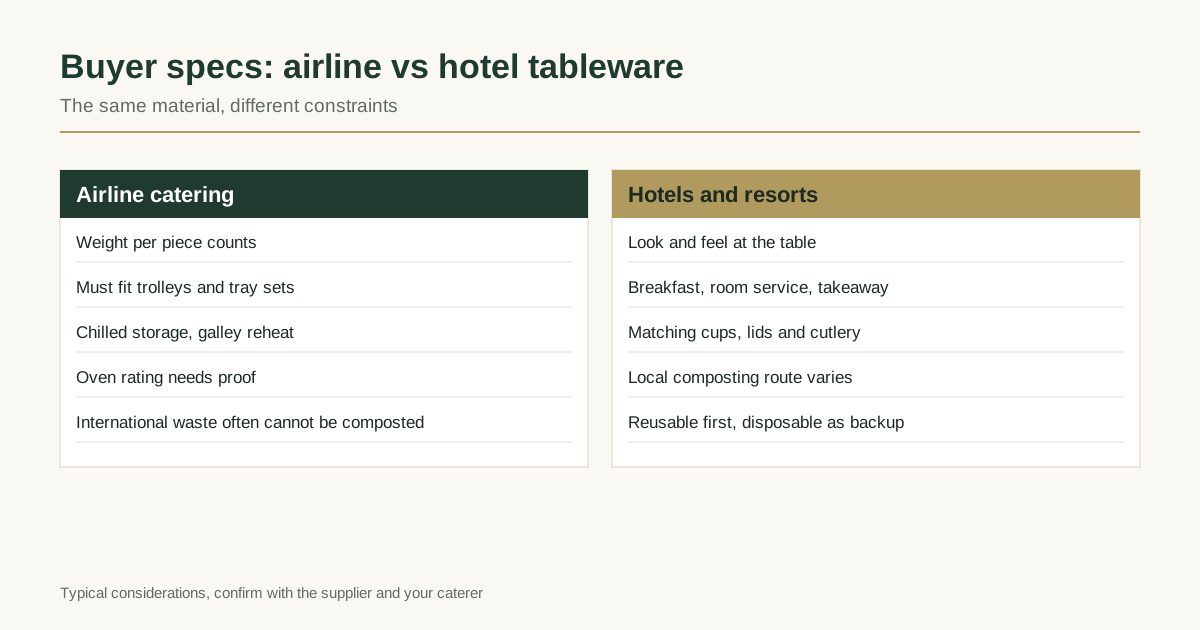
Two buyers can ask for the same plate and need different things. An airline caterer wants the lightest piece that fits a trolley and survives a chiller and a galley oven. A hotel wants a plate that looks right on a breakfast buffet and matches the cup and lid beside it. Both may say “compostable”, and both can end up disappointed if the claim is not tied to their use.
This guide sets out what each buyer type should specify, where compostable claims run into practical limits and how to brief a supplier. For the material basics, see our overview of eco packaging from Vietnam. Figures below are typical ranges to confirm with the manufacturer.
Airlines: what the specification must cover
Airline catering is a constrained environment. Items are made and packed in a flight kitchen, stored chilled, loaded into trolleys, carried across an aircraft and then handled by cabin crew in a small galley. Several specifications follow from that:
- Weight. Weight matters on aircraft, so every gram counts across thousands of meals. Specify a weight per piece and a tolerance, and measure it. A lighter piece can be thinner and weaker, so check strength with real food.
- Fit. Pieces must fit the caterer’s trays, trolleys and tray sets. Ask the caterer for dimensions and nesting limits. A piece that is a few millimeters too wide does not fit a standard slot.
- Chilled storage. Meals are often assembled and chilled hours or days before the flight. Test items in the cold chain at the storage temperature and humidity, including condensation when moved to a warm galley.
- Reheating. Many airlines reheat hot meals in galley ovens. Molded fiber is not generally rated for conventional ovens, so a hot meal may need a different container or a reheat method that suits the item. See our guide to microwave, oven and freezer tests for how to test.
- Handling. Items are stacked, handled by crew in a hurry and sometimes dropped. Test lid fit, rim strength and stacking.
- Look. Passenger perception matters. Natural beige and white both work, with embossing for branding.
The waste problem
An airline’s end-of-life claim is more complicated than on the ground. International catering waste, meaning waste from flights arriving from other countries, is tightly regulated in many regions to prevent the spread of animal disease. In the EU, for example, it is classified as animal by-product waste that is normally incinerated or landfilled, not composted. Australia and New Zealand apply strict quarantine rules too.
That means compostable tableware used on international flights may not be composted in practice. It can still reduce fossil plastic and may carry weight advantages, but you should not promise passengers that the item will be composted unless your caterer and waste handler confirm a route. Ask them what happens to the waste at each station, and word any claim to match it.
Domestic flights, lounges and ground operations may have more options, so ask for each separately.
Hotels and resorts: what the specification must cover
Hotels buy for several uses at once: breakfast, room service, takeaway, events, poolside and minibar. The priorities differ from airlines:
- Appearance and feel. Tableware is part of the guest experience. Surface, color and sturdiness matter more than weight.
- Matching set. Plates, bowls, cups, lids, cutlery and napkins should look like they belong together. Ask the supplier about coordinated ranges.
- Hot and oily food. Breakfast and room service involve eggs, sauces and drinks. Test with your menu at the serving temperature.
- Takeaway. Clamshells and cups for guests who leave with food. See our guide to bagasse clamshells for food delivery.
- Branding. Embossed logos on bases and sleeves with the property name. See our guide to embossing and printing logos on molded fiber.
- Compost route. Check whether the property or its waste hauler has a composting program that accepts the item. Many do not, and a hotel that makes a compost claim without a route risks criticism.
- Reusable first. Many hotels choose reusable tableware as the base and keep disposable items for outdoor events, takeaway and peak periods.
Specification table
| Item | Airline | Hotel |
|---|---|---|
| Weight per piece | Tight limit, measured | Less critical |
| Size and fit | Trolley and tray fit | Buffet and table fit |
| Temperature use | Chilled storage, galley reheat | Hot food service |
| Appearance | Clean and uniform | Premium, matched set |
| Branding | Embossed or sleeve | Embossed, printed sleeve |
| Waste route | Often constrained | Depends on the property |
| Packing | Sleeved for flight kitchen | Cartons for storage rooms |
| Order pattern | Forecast by routes and flights | Seasonal, by occupancy and events |
Plan for continuity of supply
Airline and hotel programs run for years, so a supplier that cannot hold a specification for three years is a risk. Ask about:
- Spec lock. Will the weight, formulation and mold stay the same over the program?
- Capacity. Can the factory ramp up for peak seasons and new routes?
- Call-off orders. Can the supplier hold stock and release by schedule?
- Lead time. Standard runs often take 30 to 45 days after order confirmation, plus sea freight, so plan inventory accordingly. Our guide to MOQ and lead time shows how to build the calendar.
- Change control. How does the supplier notify you of formulation changes, and who approves?
Documents to ask for
Request documents that cover the exact item:
- A composition statement, including fiber type, blend and barrier additives
- PFAS-free documentation and a test report if your market requires it
- Food-contact test reports for your market
- The compostability certificate, if you plan a claim, plus its scope
- Test records for heat, cold and leak use
We do not verify or confirm any manufacturer’s compostability certificate (BPI, TUV Austria OK compost, ASTM D6400 or EN 13432). Request the original and check it with the issuer. Our guide to compostability certificates and food contact tests explains what to request.
Claims on board and on site
Be conservative in wording. “Made from plant fiber” is a statement about material. “Compostable” is a claim that needs a certificate and a route. “Plastic-free” requires a check of every part, including coatings, lids and any liner. Rules differ by market, so have your compliance advisor review passenger-facing wording.
Common mistakes in airline and hotel programs
- Promising composting that the waste route cannot deliver. Ask the waste handler first, then word the claim.
- Approving a plate without a galley or chiller test. Heat and cold cycles show problems that a bench test misses.
- Ignoring trolley and tray dimensions. A piece that is slightly oversized costs far more in handling than it saves.
- Letting the specification drift. Weight, fiber blend and additives can change quietly between orders, so require notice of changes.
- Treating cups and lids as one item. They have separate documents and separate fit and heat tests.
How biopackvn.com fits in
We are a matching service, not a factory and not an agent that manages orders. You send an RFQ, we reply within 24 business hours and we introduce up to 3 Vietnamese manufacturers that suit your item and volume. You then deal with them directly on samples, testing and price. It is free for buyers, we take no commission and we sign an NDA on request. For price, MOQ, terms and shipping of a program order, see our guide to compostable packaging wholesale.
Next step
A useful RFQ for airline or hotel tableware includes:
- Use: airline catering, hotel or both, with the menu and temperatures
- Items: plates, bowls, cups, lids, cutlery and trays, with dimensions and weight target
- Handling: chilled storage, reheating method and stacking needs
- Branding: embossing or sleeves
- Volume: first order, annual volume and delivery schedule
- Documents: the list above, matched to the exact items
See our bagasse tableware sourcing page and then send your RFQ.
Frequently asked questions
Is compostable tableware useful on airlines?
It can reduce fossil plastic and weight, but compostability may not be usable on board. International catering waste is often subject to strict disposal rules, such as incineration or deep burial, to protect against animal disease. Ask your caterer and waste handler what happens to the waste before building a compostable claim.
Can bagasse tableware be reheated in a galley oven?
Do not assume so. Many bagasse items are not rated for a conventional oven, and where a limit is stated it is usually modest. Ask the supplier for a written temperature and time limit and a test report for the exact item, and test with your caterer's galley oven settings.
What do hotels usually buy in compostable tableware?
Common items include breakfast plates and bowls, takeaway boxes, cups and lids, cutlery and trays for room service or events. Hotels often choose reusable tableware first and use compostable items for takeaway, outdoor events and peak periods. Match the look and feel to the property.
BioPack VN is a matching service, not a manufacturer. Figures above are typical market ranges for planning, not quotes, and we do not confirm any manufacturer's certificates. Send an RFQ to be introduced to up to 3 Vietnamese manufacturers within 24 business hours.