Embossing and Printing Logos on Molded Fiber Packaging: Options, Limits and Costs
Key points
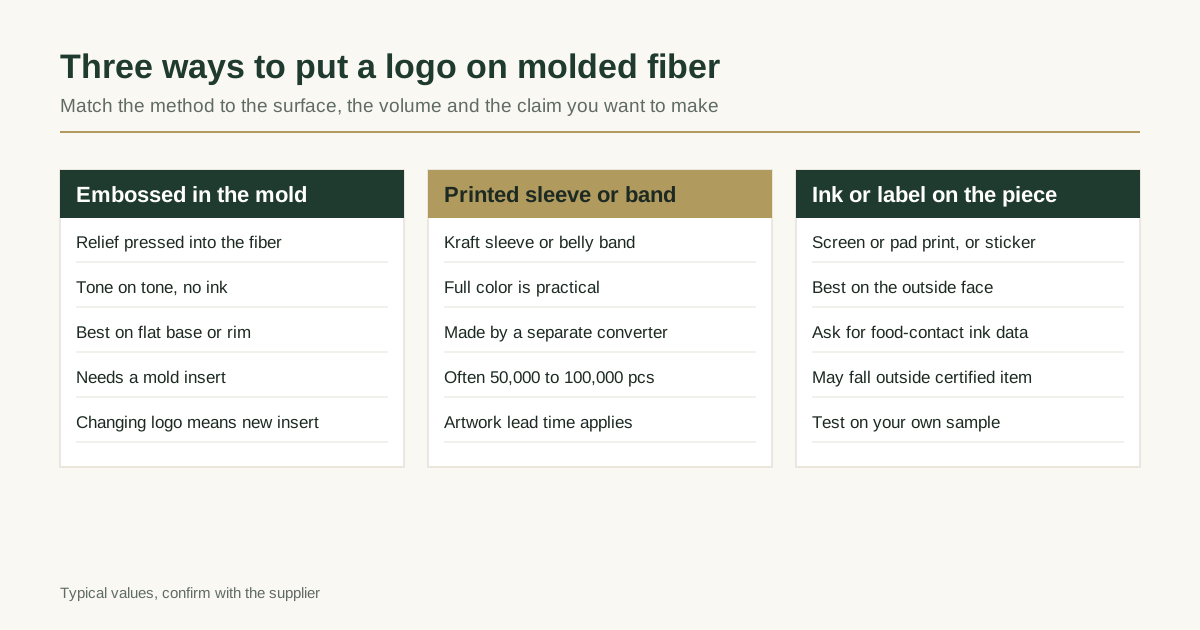
- Embossing is pressed into the fiber by the mold, so it adds no printing step, but it is tone on tone and needs a logo insert or a new mold.
- Printed sleeves or belly bands carry full color and are made by a separate converter, usually with their own minimum order.
- Ink or labels applied to the piece can fall outside the item covered by a compostability certificate, so check the scope before printing.
A plain white plate is a commodity. A plate with a clean mark pressed into the base is a brand asset, and often the cheapest one a foodservice brand can own. But molded fiber is not paper or plastic, and the usual printing options behave differently on it.
This guide compares the three practical ways to brand molded fiber (embossing, printed sleeves or bands, and ink or labels), explains the limits of each and lists what to check before you approve artwork. For the process that creates the surface, see our guide to how bagasse tableware is made.
Option 1: Embossing in the mold
Embossing is built into the heated press mold. The logo is machined into the tool surface, and when the wet blank is pressed it takes the shape, as a raised or recessed mark. It needs no ink, no label and no extra operation, and it cannot rub off.
Strengths:
- No printing step, no ink, nothing to peel
- Consistent on every piece from the same cavity
- Reads as a premium, plain look
- Adds no ink or adhesive, so the item stays closer to the version that was tested (confirm with the certifier)
Limits:
- Tone on tone. The logo has the same color as the piece. Contrast comes only from the relief and the light, so it reads best on flat areas such as the base, the rim or a plate’s flat zone.
- Detail. Fiber does not hold very fine lines. Thin strokes, small text and sharp serifs tend to blur. A simple, bold mark works best, and as a rule of thumb lines thinner than about one millimeter risk poor definition, which the factory engineer should confirm.
- Change cost. A new logo needs a new insert or a re-cut plate.
A logo insert is a replaceable plate set into an existing press mold. It usually costs only a fraction of a full custom mold, and many factories can add one to a stock shape. The full tooling picture is in our guide to custom molds for bagasse packaging.
Option 2: Printed sleeves and belly bands
A sleeve or band is a separate printed paper item wrapped around a stack, a box or a single piece. It carries full-color branding, barcodes, certification marks and instructions. Kraft or white paperboard is usual, and some converters offer recycled stock.
Strengths:
- Full color, photographs and fine text are practical
- Can show barcodes, product data and retail information
- Changing artwork means a new print run, not new tooling
- Keeps the piece itself plain, so the item certificate scope does not change
Limits:
- It is made by a separate converter, with its own minimum, often around 50,000 to 100,000 pieces for printed kraft items, as covered in our MOQ and lead time guide.
- It adds artwork approval time and a second item to schedule, since a late sleeve can hold up an otherwise ready order.
- Sleeve and carton printing runs from a different supply chain than the molded piece.
Option 3: Ink or labels on the piece
Direct printing on molded fiber is limited by the surface, which is rough, absorbent and slightly uneven. Where factories offer it, the usual methods are simple one-color screen or pad printing, or a label applied to a flat area.
Strengths:
- Allows a color mark without a custom mold
- Can work for small runs, depending on the factory
Limits:
- Surface quality. Edges blur and solid areas can look uneven, so expect a simple mark.
- Outside face only. Ink should go on the face that does not touch food. Ask for a drawing of the print area.
- Food-contact data. Ask the supplier for a declaration for the ink and adhesive, and ask which food-contact rules the inks are made under. In the EU, printing inks fall under good manufacturing practice rules for food contact materials. Confirm the requirement for your market.
- Certificate scope. A compostability certificate usually covers a specific item as tested. Adding ink, a label or an adhesive can change that scope. Ask the supplier and the certifier before you print the claim.
Side-by-side comparison
| Factor | Embossing | Printed sleeve or band | Ink or label on piece |
|---|---|---|---|
| Color | Tone on tone | Full color | Usually one color |
| Detail | Simple, bold marks | Fine detail possible | Simple marks |
| Added materials | None | Paper item | Ink and possibly adhesive |
| Setup cost | Logo insert or new mold | Printing plates or digital setup | Screen or label setup |
| Minimum | Container-level for the piece | Often 50,000 to 100,000 pcs for the sleeve | Depends on factory |
| Change of artwork | New insert | New print run | New screen or label |
| Certificate impact | None added | Separate item, check recyclability | Check scope with certifier |
All values are typical, not promises.
Preparing artwork
Whatever the method, good files shorten the sample cycle:
- Send a vector file. AI, EPS, SVG or PDF with outlines, not a screenshot.
- Simplify for emboss. Remove thin strokes and tiny text. Use one bold shape.
- Mark the position. Show where the logo goes on a drawing of the item, with size in millimeters.
- Choose relief. Raised or recessed, and the depth the factory proposes, usually a few tenths of a millimeter.
- Approve a physical sample. A rendering does not show how the fiber takes the relief. Approve the first pressed piece.
- Record the approval. Keep the signed sample and a photo on file, like any other specification item.
Questions to ask each supplier
- Can you add a logo insert to this stock mold, and what does it cost?
- What is the minimum line width you recommend for embossing?
- Who owns the insert, and where is it stored?
- Do you offer printing on the piece, and on which face?
- Which inks and adhesives do you use, and what documentation exists?
- Does adding a logo change the compostability or food-contact documents for this item?
We do not verify or confirm any manufacturer’s compostability certificate (BPI, TUV Austria OK compost, ASTM D6400 or EN 13432). Request the original certificate and check the scope with the issuer. Our guide on compostability certificates and food contact tests explains what to request.
How biopackvn.com fits in
We are a matching service, not a factory and not an agent that manages orders. You send an RFQ, we reply within 24 business hours and we introduce up to 3 Vietnamese manufacturers that suit your item and branding needs. You work with them directly on artwork, samples and price. It is free for buyers, we take no commission and we sign an NDA on request before you share your logo files.
See our bagasse tableware sourcing page for the standard range.
Next step
Include these in your RFQ:
- Item and size: stock shape or custom shape, with dimensions
- Branding method: embossed logo, sleeve or band, label, or open to advice
- Artwork: logo in vector format and the position on the item
- Volume: first order and expected annual quantity
- Document needs: food-contact and certificate documents that must still cover the branded item
Send your RFQ here with whatever artwork you have.
Frequently asked questions
Can you emboss a logo on molded fiber?
Yes. The logo is cut into the heated press mold, so it is pressed into the fiber as the piece is formed. It shows as a raised or recessed mark in the same color as the piece. Fine detail blurs on fiber, so send a simple vector logo and ask the factory engineer to review it.
How much does a logo insert cost compared with a new mold?
A logo insert on an existing mold is usually a small fraction of a full custom mold, because only one plate is cut. Ask the factory for the exact price and whether the insert can be swapped later. Confirm who owns it and where it is stored.
Can I print directly on bagasse?
It is limited. The surface is rough and absorbent, so most buyers print on kraft sleeves or labels instead. Where direct printing is offered, it is usually a simple one-color mark on the outside face. Ask for food-contact suitability data for the ink and test on your own sample.
BioPack VN is a matching service, not a manufacturer. Figures above are typical market ranges for planning, not quotes, and we do not confirm any manufacturer's certificates. Send an RFQ to be introduced to up to 3 Vietnamese manufacturers within 24 business hours.